Blog

Historic Macau — The First Encounter with Macau at Penha Hill

Historic Macau — The First Encounter with Macau at Penha Hill

On this day I spent most of the day walking the heritage trail of UNESCO-designated historic Macau.   From the HZMB Macau Port, I arrived at Sei Kee Café, hoping to get the famous pork chop buns at the restaurant. However, I learned that this 

Historic Macau — Portuguese Asia (4)

Historic Macau — Portuguese Asia (4)

Since I would like to study the heritage of Macau, I figured that a good book on Macau’s history, which is probably not widely known, is in the order. I found an exceedingly pleasant book called A Macao Narrative by Austin Coates in the library. 

Historic Macau — Portuguese Asia (3)

Historic Macau — Portuguese Asia (3)

Since I would like to study the heritage of Macau, I figured that a good book on Macau’s history, which is probably not widely known, is in the order. I found an exceedingly pleasant book called A Macao Narrative by Austin Coates in the library. In the last two, this entry and the next, I summarize the key points that I took from his book as an overall introduction of Macau’s fascinating history.

Rising British Influence in the Region

The first English ship that arrived in China was The London, which set sail from Surat, and anchored in Macau in 1635. The London was a result of the Convention of Goa, concluded in Goa by the Portuguese officials there and the president of the English Company at Surat. The Convention of Goa permitted English presence at the Portuguese ports. Since it had the capability to stall off the Dutch at sea, The London bore hope for the then dwindling Japan trade by the Portuguese. It could carry some of the much-desired goods for the journey in the Malacca-Macau-Japan route.

Yet the way that the British behaved in Macau touched off severe alarms on the part of the Chinese. Perhaps they were too aggressive, causing the Chinese to be readily suspicious of them. The Chinese considered them red haired barbarians, as the Dutch were.

The way that the first British trade fleet conducted itself in China in 1637 was one of the immediate causes for Macau’s downfall. With Captain John Weddell at the helm, this British voyage sailed far north into the Pearl River without Chinese permission, blew up a fort, burned down villages and murdered many. In response, the Chinese authorities imposed significant sanctions against Macau. China had not forgotten that it was in Macau that The London brought the first (forced) entry of the British into China. One of the key items of sanctions was the closure of the biannual Canton Fair to the Portuguese.
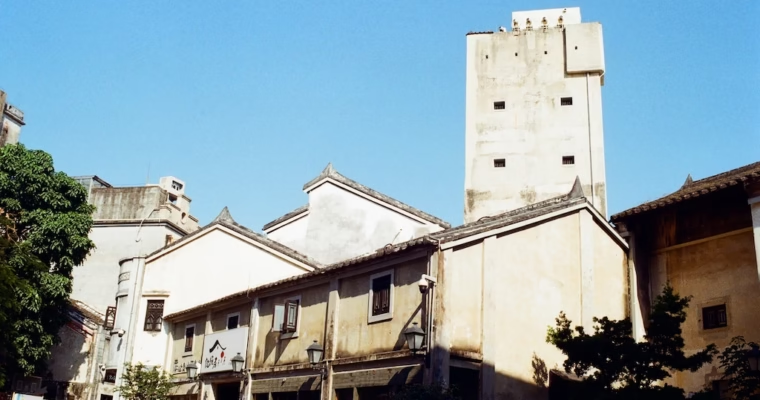
Macau continued to see a consistent decaying in its local conditions, such as crimes and murders. For the next centuries, the British would have an unruly presence in Macau—until 1841, when Hong Kong was founded, and more treaty ports were opened in places like Shanghai.

The Complete Shutdown of the Japan Trade

With the beginning of the Tokugawa shogunate came the final blow to the Portuguese Japan trade. The first Tokugawa shogun, Tokugawa Ieyasu, had significant misgivings about the western foreigners. He was wary that the feudal lords under his reign may unite under the banner of Christianity in his opposition, in which case the Spaniards would step in from the Philippines. In 1616 and 1624, he revived the Hideyoshi against the Christians. To ensure that the vessels complied with the orders against missionary presence, amongst others, the Japanese removed the rudders of the ship when they docked.

Under the third Tokugawa shogun, Tokugawa Iemitsu, all of the foreigners were banned from Nagasaki, and, including the Dutch, were relegated to Deshima, a small islet connected to Nagasaki by a bridge. In 1637, a feudal uprising in Nagasaki would seal the fate of Christianity in Japan. Many of the residents in Nagasaki were Christians. In the suppression of this feudal uprising, Tokugawa Iemitsu ordered the Shimabara massacre, killing all Christian men, women and children.

The Portuguese, by then being confined in Deshima, steadily evacuated. By 1639, all of them had left Japan. For the next two centuries, Japan would adopt an ultra-isolationist policy, permanently closing the lucrative lifeline in Portuguese trade for almost a century.

The Eventual Demise of Portuguese Asia

The trade between China and Japan were closed. By the time the Dutch seized Malacca in 1641, Macau as an entrepot had next to nothing left by way of its livelihood.

Nao ha outra mais leal, meaning “City in the name of God, none other more loyal,” was the praise of Macau by Joao IV, given in the year 1642 soon after he ascended the Portuguese throne in revolt of the joint Spanish rule. As Macau rejoiced in the victorious revolt against the Spanish, its residents sent a shipment of guns and money to the independent king.

Yet in this praise there was the sense that even the appeal to the Portuguese king would not rescue Macau from the threats posed by other western colonial powers, while at the same time the Chinese veered for control.

This incident shows an exceptional characteristic of Macau as a Portuguese colony. For centuries, it remained fiercely loyal to the Portuguese king and held on to its Portuguese character and heritage strongly. That Macau joined the revolution against the Spanish also resulted in Manila being a trade option no longer. Between the 1670s and the 1700s, Macau came to face with a poverty and general decline never seen before.

Macau’s historical trajectory took an unmistakable downturn from its heyday.

Source

Austin Coates, A Macao Narrative (1978, 2009)

Historic Macau — Portuguese Asia (2)

Historic Macau — Portuguese Asia (2)

Since I would like to study the heritage of Macau, I figured that a good book on Macau’s history, which is probably not widely known, is in the order. I found an exceedingly pleasant book called A Macao Narrative by Austin Coates in the library. 

Historic Macau — Portuguese Asia (1)

Historic Macau — Portuguese Asia (1)

Since I would like to study the heritage of Macau, I figured that a good book on Macau’s history, which is probably not widely known, is in the order. I found an exceedingly pleasant book called A Macao Narrative by Austin Coates in the library. 

The Hong Kong Museum of Medical Sciences

The Hong Kong Museum of Medical Sciences

Here comes the dog days of the summer and the thought of having to walk from sea level up to the mid-levels’ altitude for the Museum of Medical Sciences was daunting enough.

So, instead, I opted to walk from Central MTR station, via the escalators, up to Caine Road. I then headed to the Sheung Wan direction on Caine Road, then took one flight of stairs down to Caine Lane to arrive at the museum. I adored the museum building at my first sight. Under the broad daylight of mid-July, it stands proud, glistening in its historical significance as an antique monument that once gave home to Hong Kong’s first Bacteriological Institute.

A tour of the Hong Kong Museum of Medical Sciences takes about 45 minutes at the most. The exhibition on the history of Hong Kong medicine was informational, so was the educational video upstairs. Otherwise, the really key thing to see was the laboratory, also on 2nd floor, which has preserved the original features of the Bacteriological Institute.

A Brief Look at the Historical Development of Hong Kong’s Medicine

The urgency of studying bacteriology became apparent after Hong Kong emerged from the bubonic plague of 1894. The epidemic terrified the Chinese community of Hong Kong, equally so in both health and cultural dimensions. The bubonic plague, also known as black death, caused significant deaths and enormous suffering. The Chinese people at the time also resisted the Hong Kong Government’s efforts to forcefully sanitize their homes and to handle the corpses. It was a political and health crisis in one.

In 1906, the Bacteriological Institute began serving as a key medical institution in Hong Kong that addressed infectious diseases and bacterial pathology. The need to institute such a facility arose as a public health lesson learned from the bubonic plague. For decades, it was a laboratory of infectious pathology, until the 1950s. It then served as a vaccine production center until the 1970s.

The first hospital for the Chinese people were established in 1872. It provided services in traditional Chinese medicine as the predecessor of Tung Wah Hospital. The awareness for public health standards were introduced by the publication of Osbert Chadwick’s Report on the sanitary conditions of Hong Kong in 1882. In 1887, Sir Ho Kai donated the funds necessary to establish the Alice Hospital in the name of his beloved late wife. That was the first western hospital dedicated to serving the Chinese community of Hong Kong.

The Hong Kong College of Medicine for Chinese, an initiative of Sir Ho Kai and other practicing private doctors, would become the first institute of tertiary learning in Hong Kong. Beginning in 1887, it carried the torch in the education of local talents in western medicine. It is worth mentioning that Dr. Sun Yatsen, who would eventually lead a successful revolution against the Qing imperial rule of China, was a graduate of the Hong Kong College of Medicine for Chinese. The Hong Kong College of Medicine for Chinese was a founding faculty (the Faculty of Medicine) at the inception of the University of Hong Kong in 1912.

The Museum of Medical Sciences as a Heritage Site

Formerly the Bacteriological Institute, the Museum of Medical Sciences was intimately related to the bubonic plague of 1894. Tai Ping Shan, a densely populated residential area for the early residents of Hong Kong Island, located in Sheung Wan, was a site of heavy casualties.

At the time, the hygienic conditions in the Chinese communities were terrible. There were no sanitary or even automatic water supply facilities in the typical two-story tenement homes in the area. Tai Ping Shan was also notorious for its shallow graves, the corpses of which were often exposed by rain and weather conditions, posing significant distress and health risks.

It was during the bubonic plague that then Hong Kong Government shuttered the whole neighborhood of Tai Ping Shan and required an evacuation of all residents. After the bubonic plague, the Government then rebuilt the whole neighborhood. The Bacteriological Institute was established in 1906 in the former Tai Ping Shan neighborhood, dedicating itself to the study of infectious diseases.

The two-story building comes in the Edwardian style of architecture and a tiled gabled roof. Its exterior lined in red bricks, the building features also arched windows with ornamental lining.

Viewed in the front, central bays with arched façades and Romanesque columns adorn both levels, as windows on the top level and the entrance gateway on the ground level. “The pilasters and attached columns framing the windows have iconic capitals.” (Official Website of the Museum of Medical Sciences)

The upper story comes with balconies, a feature that aimed to address the tropical climate of Hong Kong. Unlike other typical early colonial era buildings, however, the Museum of Medical Sciences does not feature a veranda. It is nonetheless stately in its own right.

The Edwardian features also some typical interior features of early colonial era buildings, with elegant staircases, wooden flooring and a furnace for the dampen cold days.

The heritage site, which would eventually become the Museum of Medical Sciences in 1996, was named a declared monument in 1990. Before being repositioned as a museum, it was known as the Old Pathological Institute.

The address of the Museum of Medical Sciences is 2 Caine Ln, Sheung Wan.


Sources

Descriptions on site at the Museum of Medical Sciences.

The official website of the Hong Kong Museum of Medical Sciences.

Historic Macau — Preliminaries

Historic Macau — Preliminaries

The series on Macau is long overdue. I visited Macau during the October 1st golden week, traditionally a week-long holiday in China. I was thus fortunate that I saw the National Day fireworks during this trip. I have been to Macau many times before, but 

Shenzhen Shorts — The Food of Nanao

Shenzhen Shorts — The Food of Nanao

As compared to the western shore of Nanao, the eastern segment comes with significantly less choices when it concerns food. We had meals both in the eastern and the western shores, and here’s a list of food recommendations. The order does not reflect a ranking. 

Shenzhen Shorts — Dongshan as the Last Pearl

Shenzhen Shorts — Dongshan as the Last Pearl

As the taxi pulled over to Dongshan Village, I sensed that it was a provincial part of Nanao at which we would be staying. The Mello Hotel is located in the newish touristy area of the Dongshan Village.

Meaning “the eastern mountain,” the Dongshan Village has a history of settlement that dates back to the late Ming dynasty. For a very long time, the Nanao peninsula came under the administrative jurisdiction of nearby Dapeng. Dapeng is namely the south-eastern-most region of Shenzhen. At its northern end, Huizhou, as part of the Guangdong Province, begins.

Author Lv Shili spent three years interviewing the villagers of Dongshan about their heritage, their lives and their aspirations. The book The Last “Pearl”— Report from Dongshan Village weaves together the themes that continue to concern the people of Dongshan Village as the back quarter fishing town of Dapeng moves forward from the former industry of pearl harvest.

A Time of Glory – The Pearl Harvest of Dongshan

In this area of Shenzhen, the pearl industry goes as far back as 1,000 years ago as recorded in the historical scrolls. The part of history that has pan-generational significance in the lives of the current villagers was the pearl rearing and harvesting fields that began in the 1960s in New China.

The pearl farms were state owned, but often times requiring the help of the Dongshan villagers. This enterprise reached its heyday during the 1980s, when sizeable production facilities arose to meet the need for secondary pearl products, such as pearl powder for skincare, jewelry and other pearl inlaid decorations. The pearl industry was so developed that tourism features, such as shops and food and dining, were also introduced during this time. One could only imagine the glory of such business for an otherwise agrarian community.

These pearls, being from Nanao, acquired the beautiful name nanzhu, meaning the “southern pearl.”

For decades, the people of Dongshan relied on the pearl farming opportunities as their first order of livelihood. The next option for them would be fishing and agriculture. The pearl industry was slowly phased out during the 1990s or so. Since then, the villagers have struggled to find the opportunities that could emulate the boom that followed the pearl industry. As of now, it is apparent that Nanao’s aspiration for tourism would benefit them.

The Ancient Tin Hau Temple in Dongshan Village

In all Cantonese communities of China, Tin Hau, as the Goddess of the Sea (also called Mazu), is worshipped in the coastal areas. It is no different for the people of Dongshan. The recorded history of this Tin Hau Temple of Dongshan suggests that it has had more than 500 years of history, since the Ming dynasty.

Originally, the temple was built upon two big rock formations that lied in the middle of the sea. The worshippers had to row their boats to visit the temple. Due to the land reclamation efforts in the past few decades, the water level receded, the land area expanded. As such, the Tin Hau Temple now stands within the standard landform in the Dongshan area.

Photo above: You can see the big rock upon which the Tin Hau Temple of Dongshan was built in this photo, right by the large century-old banyan tree that is also very much the temple’s history.

To this day, traditional festivities celebrating the birthday of Tin Hau are held annually, featuring traditional Cantonese opera performances, with joss stick and incense burning at an enormous scale. It is certainly a remarkably festive time of the year.

The Dongshan Pier

This photograph above shows a surreal view of the Dongshan junks in the evening. The lighting of the pier bestows a sense of unreality. In daytime, the Dongshan Pier does not look an ounce of the beauty that it has at night. The junks are old fishermen boats, certainly workable but nothing close to the beautiful yachts at the YUN Hotel.

Yet this pier was once the lifeline for the Dongshan Village. Because of its vicinity to the Hong Kong waters in the south, the Dongshan Pier was once a major port for the transport and sale of opium during the 19th century. The British opium merchants docked their fleets here first, then distributed their goods to all other locations. Their demand for food and entertainment resulted in a short-lived era of economic boom at the pier.

Such was the Dongshan Pier’s last life. When Japan invaded China in the 1930s, its fate would turn and its glory never restored. The Japanese burned down the Dongshan Pier in 1938. Since then, the original population of Dongshan dropped to the lows of just a few big surnames remaining. The current villagers of Dongshan are mostly new arrivals since the establishment of New China.

Today, the Dongshan Pier continues to serve a most basic function, as the place where the fishermen go out to sea for their catch. The fishermen of Dongshan sell their goods as soon as they return from sea. In times of typhoon, the Dongshan Pier can provide refuge for about 70-80 boats.

Dongshan Fishermen’s Songs

The Dongshan Fishermen’s Songs are likely the proudest intangible heritage for the people of Dongshan. The lyrics of the fishermen’s songs “cover almost every aspect of the fisher folks’ lives.” It is much of an oral tradition, as generations of illiterate fishermen pass on these songs. But also certainly that a lot of the songs are improvised. There is a fishermen’s songs team in Dongshan now, and most of the singers are mid aged women that come from the fishermen’s heritage. They perform in government sponsored events every now and then. In their standard repertoire are 31 songs featuring fun rendition of their lives at sea.

At the Tin Hau Temple, there is a loudspeaker that runs a sample of the fishermen’s songs on a loop. The songs are sung mostly in the Dapeng and Hakka dialects.

Traditionally, the fishermen communities of China are considered relatively low in the social hierarchy. For a very long period of time, they are not allowed to live on the land at all. Throughout those long years that Dongshan experienced the many turns of fortunes, some fishermen in the community have managed to secure their homes on land. That certainly was a step up for them.

There are many Chinese restaurants that specialize in seafood making in Dongshan, and they serve, quite exclusively, the daily catch of their own fishermen. I happened to have one meal at these local seafood restaurants closed to the Mello Hotel.

Sources

Descriptions on site at the Tin Hau Temple of Dongshan Village.

Lv Shili, Zhou Xiaoxin, The Last “Pearl,” Report from Dongshan Village (2020).

Shenzhen Shorts — The Western Shore of Nanao

Shenzhen Shorts — The Western Shore of Nanao

We wanted to have a leisurely lunch at the YUN hotel but the dining options there were limited. We then decided to head over to the western shore of Nanao. The ride would take a little more than half hour. Nanao has the beautiful name