Blog

The City of Rams – Local Food in Liwan and the Origin Antique House and Hotel

The City of Rams – Local Food in Liwan and the Origin Antique House and Hotel

I walked for about 8-10 minutes from the Changshou Lu Metro Station to the Origin Antique House and Hotel. Even from afar it looked delightful. It was clearly an old and a much larger structure even compared to the many old houses I saw on 

The City of Rams – Déjà Vu in Guangzhou

The City of Rams – Déjà Vu in Guangzhou

It feels very familiar in Guangzhou. The people, the streets, the structures. I have certainly been to Guangzhou before, perhaps even before the rapid economic development that took off after 1992. The trips to Guangzhou during my childhood years have not left me with any 

Shenzhen Shorts – The Gankeng Ancient Hakka Townlet

Shenzhen Shorts – The Gankeng Ancient Hakka Townlet

It was a hot day but I was keen on seeing the Gankeng Ancient Hakka Townlet in Shenzhen. From the Futian boundary crossing, I made it onto Shenzhen’s MTR and got off the Gankeng Station on Line 10. Then I walked about 8-10 minutes on Gan Li Road to arrive at the ancient city gate of Gankeng.

First Impressions of the Gankeng Ancient Hakka Townlet

The ancient city gate greets visitors with a typical pagoda top with a tiled roof and an arched entrance beneath. I felt very excited by this sight. It has been years since I saw similar structures in China, and this would be my first proper trip to an ancient city after the pandemic.

Once entering the gate on its stone-paved road I came upon the map showing the recommended features for visitors.

But first of all, I must have lunch somewhere. Since Gankeng has a Hakka origin, I thought it would be a natural choice to have Hakka cuisine. I simply found a proper-looking restaurant on the outskirt of the town to sit down for a meal.

Ke Man Yuan serves Hakka cuisine. Despite my excitement, however, I made a mistake of ordering a Salt-Baked Chicken, which is a Hakka specialty, but the chicken was too salty and too tough. I felt like I was eating a chicken that was hard boiled in soup. But my wok fried veggies was very good.

About the Gankeng Ancient Hakka Townlet

The first official record of the Longgang Area, in which the current Gankeng Ancient Hakka Townlet was located, appeared in the Gazetteer of the Xinan County during the 27th Year of the Kangxi Reign of the Qing Dynasty (1688). By the 9th Year of the Tongzhi Reign (1870), the Longgang Area was an established administration. During the Ming and Qing dynasties, the Yao ethnic minority populated this area. By the early Qing Dynasty, the Hakka people have also moved to this area in large numbers. In time, their heritage will become that which Gankeng is now known.

The Gangkeng Ancient Hakka Townlet as it stands now have a history of about three hundred years. But archaeologists have found evidence of settlement at a much earlier time, even as far back as the Qin Dynasty, and certainly also of the Song Dynasty as well.

The villagers of Gankeng were farmers, and besides agriculture, they also relied on their handicraft of the “cool hat” for a living. As the economy of southern China changed over the decades since the 1950s, the villagers have also begun to work in factories, but Gankeng remained a poor community. The basic facilities of water provision and plumbing were only available here in the 1990s. With Overseas Chinese Town Holdings Company taking over the revitalization of the area in the 2016 (more below), Gankeng finally saw better days.

A leisurely walk in Gankeng will take at least 2-3 hours, especially during the summer. There are many old structures that are exceedingly picturesque. Feel free to get a little lost in the many alleyways, in which you will see many smaller old structures there that are perfect for picture-taking. The landscaping is also well done, especially in the pond area. In the following, I will point out a few must-visit spots in the area.

My lunch was a little disappointing, and I certainly recommend trying out the many restaurants and snack shops within the ancient townlet. There is also a “Yao” chicken, which is baked in a Chinese-styled clay oven. It is a native cuisine that is worth trying.

The Gankeng Museum

The “cool hat” of Gankeng is considered an intangible heritage. Even during the times when the ethnic Yao people settled in Gankeng, the broad leaf bamboo (Sasa longiligulata) that produced the prime material for the “cool hat” were growing abundantly in this area. The Hakka “cool hat” is traditionally a handcraft of the Hakka women. Its main material is bamboo, with a hole in the middle and cloth surrounding the rims so to taper the heat.

The Hakka cool hats of Shenzhen come with two regional styles. The Gankeng cool hats have black cloth, and the bamboo is plain without paint. The Dapeng style comes with blue cloths, with the bamboo part painted in red.

Furthermore, the Hakka cool hats was a way to distinguish the status of women. Young, unmarried maiden wear cool hats with white fringes. Young, married women wear cool hats with red fringes. For older married women, the fringes of their hats are usually black, green or striped in these colors.

The Gankeng Museum was delightful and that was quite surprising to me. The exhibits were well-arranged and the narratives were educated and sympathetic to the Hakka story.

The Gun Tower

The gun tower at Gankeng is a typical structure in many of the ancient villages of Shenzhen. It is built of concrete, with four floors and served the primary purpose of defense against bandits. The villagers also used it for educational purposes. The Gun Tower of Gankeng is attached to the “pai” houses, meaning a row of houses. It was built during the Republican Period.

The Zhuangyuan (Scholar) House

This structure was built during the Qing dynasty and it has 300 years of history behind it. This is dedicated to the Zhuangyuan (the best scholar in the Qing imperial examinations). However, it was closed when I visited.

The Wenchang Tower

It took me a while but I did find the way up to the Wenchang Tower of Gankeng. The Wenchang Tower is a structure of the Tong ethnic minority. The tower is in the shape of an octagon, and this tower has 11 levels. The Tong ethnic minority believed that the tower should be built before they build their settlement homes. The tower is the public space for meetings and community entertainment. As a complex structure to build, the Wenchang Tower signifies good fortune for the people.

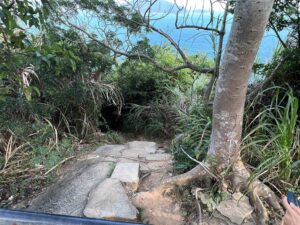
Photos: Left — the way up to the Wenchang Tower. Right — the Wenchang Tower.

After resting a bit at the tower, I headed back down and picked a café to cool down and rest a bit. I found Li Lu, and their iced mango drink was very satisfying on this hot summer day. There are a lot of such cafes in the area.

Restoration Effort of the Gankeng Hakka Ancient Townlet

Even up till the 1990s, Gankeng remained a community of very modest means. The revitalization of the village was a result of efforts led by the Overseas Chinese Town Holdings Company and the residents themselves. The restoration began in 2016.

To be fair, I really do think the revitalization was successful. Surely, this model of restoring aged communities into a mixed heritage and business establishment cluster must involve some loss of the community’s original character, and the businesses that prop up all over what should have been a mostly cultural space are signs of over-commercialization. But in my humble opinion, this would be the most sustainable model of heritage preservation, and the involvement of the OCT, which is a quasi governmental enterprise, is necessary.

Beautiful Sha Tau Kok – A Tour of WWII Sites

Beautiful Sha Tau Kok – A Tour of WWII Sites

I have always wanted to visit the war sites of Sha Tau Kok, but despite my best effort I was not able to locate them. I finally found a guided tour organized by the Stonehouse Family Garden. This tour would take me to these sites 

A Walk in the Clouds in Tai To Yan

A Walk in the Clouds in Tai To Yan

There was quite a bit of an overcast on this day, but the weather was cool and so we decided to go ahead with a walk on Tai To Yan. The itinerary of the day is to begin in Fanling and enter the mountains via 

The Lovers’ Rock on Bowen Road

The Lovers’ Rock on Bowen Road

The Lovers’ Rock is rumoured to bring good luck in the love department. In this week before the Lunar New Year, I was looking for an easy trail for a much-needed walk. Since Bowen Road is in the vicinity, I thought I could also bring in some good luck with a visit to the Lovers’ Rock on the way.

The Bowen Road Fitness Trail

The Bowen Road Fitness Trail is a very popular trail for all sorts of activities. Many people like to do a quick along-the-city walk. Many more jog on this trail. Still more walk their dogs there.

The trail stretches from Wan Chai all the way to Stubbs Road. As such, you will be seeing some pretty good city views northward and eastward.

From the entrance point from Bowen Drive to the end point at Stubbs Road, the trail is only 2.6km. If you enter from Bowen Drive, the only incline is between Kennedy Road and Bowen Drive. Once you reach Bowen Road, you will be on a level walk throughout.

To walk this way, you will begin on the 17th floor of the Hopewell Centre. Enter into Hopewell Centre on Queen’s Road East, then take the elevators up to the 17th floor. Exit the building onto Kennedy Road, then facing south, head up on your right. Soon you will arrive at Bowen Drive, take the incline up, and you will reach Bowen Road Park. That is the way to enter the Bowen Road Fitness Trail.

The Wan Chai Gap Road Entry onto Bowen Road Fitness Trail

To clock in some exercise, I chose to enter Bowen Road from Bamboo Grove on Kennedy Road, via Wan Chai Gap Road. This incline is a bit rigorous but certainly very doable.

Again, start at Hopewell Centre 17th floor. On Kennedy Road, facing south, make a left instead, and go all the way to Bamboo Grove. You will see the slope up at this point with signage pointing you to the way of Bowen Road.  That is Wan Chai Gap Road. After climbing this slope, there is no more incline on the trail.

Once you reach this point at Wan Chai Gap Road, make a left (eastward) and continue on Bowen Road to find the Lovers’ Rock.

The Lovers’ Rock

The Lovers’ Rock is known locally to be particularly auspicious for love, that it always brings together lovers who pray for their relationship to bear fruits, or give children to those who pray for fertility.

According to the Wikipedia, a tragic love story gave rise to the lovers’ rock becoming the augury for love.  A Japanese soldier fell in love with a local woman during WWII. Their love was forbidden, and they opted to commit suicide here. They were turned into the Lovers’ Rock. Later, they appeared in the dreams of local women, telling them that if they would tender sincere prayers at the rock, their wishes for love will come true. It thus became the urban legend that we know today.

As to the claims of enabling fertility, it is of course quite obvious that the shape of the rock resembles that of the male reproductive organ. I guess that is not subject to debate.

The Lovers’ Rock lies quite close to the Wan Chai Gap Road entry on Bowen Road. There is a flight of stairs to climb before reaching the rock. The whole walk, including the Lovers’ Rock, will take about an hour or so.  There are generous shades throughout and quite a number of resting spots.

Finally, toward the end of the Fitness Trail, you will come across the Boundary Stone for Victoria City.

The end of Bowen Road meets Stubbs Road. There are many buses and minibuses for you to take back to the city.

How to Get There

Reach the 17th Floor of Hopewell Centre for both entry points introduced in this entry.

Source

The Wikipedia on the Lovers’ Rock (Chin).

Tai Shek Mo and Its Military Installations in Sheung Shui

Tai Shek Mo and Its Military Installations in Sheung Shui

At the peak of Tai Shek Mo, of 183 meters in altitude, there are all-around views of New Territories North including that of all of Sheung Shui and much of the southern skyline of Shenzhen. Needless to say, the fish pond views of Ma Tso 

Since 1966 – Steak on Flames at The Boston Restaurant

Since 1966 – Steak on Flames at The Boston Restaurant

The Boston Restaurant in Wan Chai has been serving its signature dish, Beef Brochette Flambé, since 1966. Today I took a leisurely lunch there and had a delightful steak that came with amazing theatrics. The experience was really quite special. The Story of Boston Restaurant 

Islam Food in Kowloon City

Islam Food in Kowloon City

Islam Food in Kowloon City has a long-standing presence as one of the few Islam dining establishments in Hong Kong. I finally had a chance to visit it for some of its famous dishes. And I would certainly go back for more.

Some Basics about Halal

In most religions of the world there are dietary rules and restrictions for its believers. Even for Protestants the Old Testament does lay out some specific rules, and they perhaps still govern the Jewish people’s diet to this day. Islam is also very strict with the dietary requirements for its followers.

According to the Wikipedia, “The term halal is particularly associated with Islamic dietary laws and especially meat processed and prepared in accordance with those requirements.”

The obvious feature of halal is that pork is forbidden. Pigs are considered unclean under Shariah Law. The next two obvious excluded categories are blood and alcohol.

The strict prohibition of these categories certainly results in very limited choices for the Muslims in Hong Kong. As a predominant Chinese dietary preference here, pork is a major meat category; pig blood is considered a delicacy. Alcohol is also a standard marinate in food. This would naturally present some difficulties for Muslims in Hong Kong. Halal does not allow any “contamination” of unclean foods in the kitchen utensils. Therefore it is not simply a matter of not ordering a pork dish in a restaurant. If the restaurant serves pork at all, then all its utensils would be considered unclean.

In a strict adherence to halal requirements, one must begin with the right way of slaughter. First of all, there is a scripture to recite before the slaughter. Then comes the right way of releasing the blood completely in the animal, as the blood shall not spill over to the meat. The person who slaughters the animals must also be Muslim. This practice continues to this day at Islam Food.

Finally, because Islam prohibits alcohol, Islam Food does not serve any alcoholic beverages. Nor can diners bring alcohol for consumption on-site.

The lack of proper Islam food in Hong Kong has encouraged the first-generation owner of Islam Food to open an eatery that meets Muslim requirements.

The Story of Islam Food

Islam Food is a family-owned, family-run business that began in 1950. The Ma family are Muslim for generations. Like many of the long-standing restaurants in Hong Kong, those that started in the 1950s had humble beginnings. Islam Food was simply some kind of a “food stall” somewhere, and in more than one location. There was not even a proper name for it. The food offered was simple noodles, buns and meat-filled type of savory pastries.

In the 1980s, the business moved into a proper dining facility in Kowloon City, and it has since then established a notable presence and reputation in the community.

The Famous Dishes at Islam Food

Perhaps the most popular dish at Islam Food is the pan-fried beef pockets. I had high expectations on this.

Originally, the beef pockets were very big, and the Chinese name for it was “beef box.” It really did come in like a box full of meat. After customers reflected that the “beef box” was too big, they became “pockets” instead. The customers were looking to be able to try different dishes besides the beef pockets too.

I always enjoy food that has “juice splurt,” such as the Shanghainese Xiaolongbao. And the beef pockets did not disappoint. The juice flowed out as the first poke of my chopsticks. I placed my spoon below to catch all that goodness overflowing from the pockets. Beware and not to rush, for the pockets are served red hot from the pan. I thought it was perfect to dip the beef pockets into a little bit of black vinegar. The bite comes in a complex sensation of crispiness, juiciness, and the richness of flavors.

The next dim-sum style dish that I ordered was the beef pot stickers. Again, there was juice splurt in these delightful pockets of goodness.

Finally, I ordered a simple beef shreds in soup vermicelli with fried tofu to complete the meal.

What I did not order on my first try, but a must-order if you are to go, is the curry at Islam Food. The style of the curry there is Pakistani. The first owner of Islam Food began as a chef at the police station canteens. Since there were many Pakistani policemen at the time, he learned the right way of making Pakistani curry from these policemen. The spices are made to the specific order of what this restaurant requires by the supplier. And there are more than 70 spices in the curry at Islam Food. Needless to say, the original Pakistani curry would have been too spicy to Hong Kong people’s liking. Therefore there were efforts to tame down the spiciness to meet this preference. As halal, the selection of meat for the curry are beef, chicken and lamb.

What distinguishes this type of curry from the others is that the curry has bright orange or red color. The curry here does not have any coconut milk, instead there is a heavy use of onions.

How to Get There

The address of Islam Food is G/F, 33-35 Tak Ku Ling Road, Kowloon City.

Sources

The Wikipedia on Halal.

Interview with Mrs. Ma of Islam Food, The Golden Plaque, Metro Radio available here.

The Wonders of the Ex-Sham Shui Po Service Reservoir

The Wonders of the Ex-Sham Shui Po Service Reservoir

Perhaps a couple years ago, the government had plans to pull down the Ex-Sham Shui Po Service Reservoir. The netizens then leaked some photos of it and caused an uproar. The beautiful imitated Roman architecture fascinated the people of Hong Kong. What followed was an