Blog

Distinctly Hong Kong – Dai Pai Dong

Distinctly Hong Kong – Dai Pai Dong

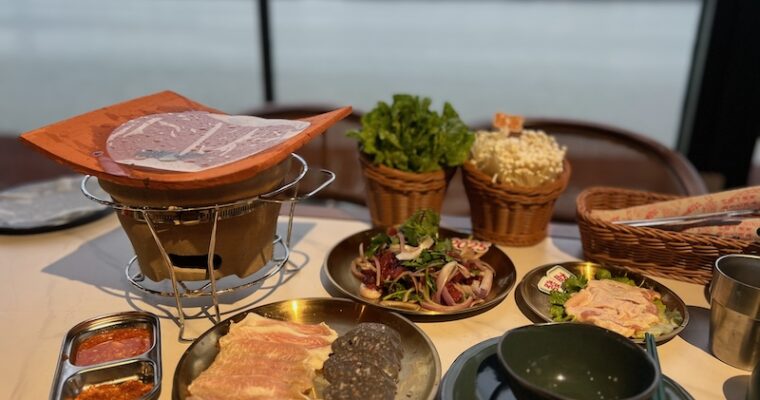
Besides the Cha Chaan Teng’s, the Dai Pai Dong’s are also a way of dining that is distinctly Hong Kong. In recent months I have had the pleasure of visiting a few Dai Pai Dong’s in Hong Kong. I do consider the Dai Pai Dong’s 

In Their Footsteps – The Food of Jiangmen

In Their Footsteps – The Food of Jiangmen

The train to Shenzhen would depart in the early evening and I debated how to spend the day in Jiangmen. To be honest, there was not very much in this city that I wanted to see, as I was almost always only keen on heritage 

In Their Footsteps – 33 Hui as the Origin of Jiangmen

In Their Footsteps – 33 Hui as the Origin of Jiangmen

I have a very favorable impression of Jiangmen due to a personal memory of my grandma. When WWII began, resources were scarce. She would take her mother’s Qing dynasty clothes to the merchants of Jiangmen in exchange for money. “One piece of my mother’s Qing dynasty tunic could be tailored into a few pieces of modern style clothing,” as she would tell me. Indeed, Jiangmen had every geographical feature that gave rise to its emergence as a key trading port in Guangdong Province.

The History of Jiangmen

Meaning “The Gate of the River,” Jiangmen at its inception as a trading port was an area flooded by the waters of Pengjiang River. Two islands, as mountains submerged in the river, were the land mass in this area. Jiangmen was the river mouth, where the river merged with the ocean. The view of these two mountaintop islands standing opposite to each other created the imagery that inspired Jiangmen’s name. The mountaintop islands were the gate of Pengjiang River.

Impressions of 33 Hui

From Nan Lou in Kaiping we called a car to ride for more than an hour before reaching the vicinity of 33 Hui, a photogenic area in Jiangmen. We had to walk through a web of alleyways to find it.

Photo: A nice alleyway on the way to 33 Hui

You can’t miss the oldest marketplace of Jiangmen, however. From every turn of the streets at 33 Hui, a sense of assuredness emanated. From the introductory signs there one sensed a pride revived — a dilapidated part of the city being thrusted into the national limelight because a popular Chinese TV drama called Kuangbiao (2023) was set in here.

Photo: A hair salon on Jingguo Jie capitalizing on the TV drama that was set in 33 Hui by offering hairdos that replicate the hairstyle of the TV drama’s characters.

Toward the dusk hours we headed into a world of old qilou’s, the sprawling arcades that typified the old urban developments of southern China. As the daylight waned, the street lamps casted a yellowish hue upon a busy street scene, unveiling an age-old community that has stood tall amidst the currents of time.

Yet 33 Hui clearly struggles between meeting the day-to-day needs of the locals and the sightseeing demands of the tourists. Throngs brushed shoulders under the arcades. Hawkers and proper shops alike placed their goods for sale, encroaching on the pedestrian walkways, and rather shamelessly so.

We were overwhelmed and opted to walk on the motorway instead. The loud honking of the vehicles brought us back to a time that my friend and I grew up in, when Hong Kong’s own streets held pedestrians spellbound in its chaos. We realized fully then that we have long lost a survival skill.

The History of 33 Hui

33 Hui, pronounced “Sanshisan Xu” in Mandarin, is known to be “the origin of Jiangmen.” Meaning “the 33 market,” this area of Jiangmen was established during the late Yuan and early Ming dynasties.

Photo: The 33 steps of 33 Hui are the most photographed in this part of Jiangmen

As early as 1363, during the Yuan Dynasty, a marketplace was set up in this area of Jiangmen. Situated on the western slopes of Penglai Mountain, the Jiangmen Market was the beginning of trade in the Jiangmen area. The street that was located on the very top of the market was called Xuding Jie (Top of Market Street), and it has remained so to this day.

33 Hui acquired its name due to the 33 steps on the major stairway in the market. This was the stairway that traders embarked upon to reach the marketplace from their arriving boats loaded with goods.

Photo: Jingguo Jie, a street for fruits

The names of the streets in 33 Hui convey a cultural history that echoes the aged structures on the streets. The street names indicate the kinds of goods being sold in those very early days of market life. Maijidi, for example, referrs to the fact that chickens were sold in this section of the market. Zhuzai Xu was then aptly named for the section that sold pigs. Streets named lantern and coffin suggest that the market offered all varieties of goods that met the needs of life, from food, to home furnishing, to netherworld necessities.

With careful navigation we made our way through to some of the most-visited spots in this area. Neither of us has heard of the TV drama. But we did see why 33 Hui is a good spot to film. As opposed to the studio city in Chikan, 33 Hui remains somewhat dilapidated and certainly unadorned. What stands out to a visitor of 33 Hui is a vitality that rises above the signs of decay. The neighborhood is assured of its meaningful existence as the origin of Jiangmen, and it will continue to shine as such.

Sources

Descriptions on site at 33 Hui, Jiangmen, Guangdong, China.

In Their Footsteps – The Martyrs of Nan Lou

In Their Footsteps – The Martyrs of Nan Lou

The theme of security and protection has been prominently featured in the diaolou’s that I have visited in Kaiping. But Nan Lou is perhaps the only diaolou that came with an official history in the defense of the nation. We called a car to take 

In Their Footsteps – The Chikan Ancient Town

In Their Footsteps – The Chikan Ancient Town

My friend and I went to Kaiping because she saw an ad on the MTR in Hong Kong promoting the Chikan Ancient Town. As such, it was with a whole lot of anticipation that I arrived at Chikan from Majianglong Village. And, to say the 

In Their Footsteps – The Majianglong Village

In Their Footsteps – The Majianglong Village

I had to hurry through the Majianglong Village because time with the hired car was up soon. Even a quick walk through the village brought forth quite a different experience from the previous two sites that I visited, the Zili Village and Liyuan Garden.

Majianglong Village became a designated diaolou viewing spot more recently than the Zili Village. As a result of becoming a designated tour site, Majianglong Village met a turnaround of its circumstances: a bridge was built to connect the village to the highway network in Kaiping.

I had no time to visit the interiors of the diaolou’s there. Instead, I rather enjoyed the shaded walk amidst the bamboo woods throughout the village. The sites are spread throughout the village, and even a quick walk would take at least 45 minutes.

The History of Majianglong Village

Majianglong Village was established in the late 19th to early 20th century. Five villages make up the hamlet. The villagers are of the Huang and Guan clans. In this village about 13 diaolou’s are located along a shady path that meanders through other shorter, century-old village homes. It is in this wholesome setting that one embarks on a heritage walk full of pleasant surprises.

A Tour of the Diaolou’s at Majianglong Village

It was near-poetic to walk through Majianglong Village and its diaolou cluster. It was a world in itself with an environ that fuses nature seamlessly with human footprints.

The first sighting of a diaolou appeared right at the village entrance.

The Tianlu Lou

The Tianlu Lou is namely the most famous of all the diaolou’s in Majianglong Village. As a zhonglou, it came into existence by the villagers’ pooling of funds intended for a communal residence with defensive features. 29 villagers of the Huang’s contributed to the construction of Tianlu Lou in 1925. It is believed that Tianlu Lou costed 12,000 silver coins to build.

The nature of a zhonglou is seen in how the villagers used this building. In this part of Kaiping at those times, the bandits menaced the villagers. The bandits eyed the enormous wealth of the overseas Chinese and abducted young children for ransom. Tianlu Lou was for the male members of those families that contributed funds to this building to rest at night.

Needless to say, such an expensive building would come with the most thoughtful amenities for its residents. There are 29 bedrooms in total from the 1st to the 5th floors. The 6th floor is a communal room, and the 7th floor is a lookout station. The very top floor is fitted with a four-cornered pavilion with a pyramidal roof.

The poetic walk into the Majianglong Village followed the brief look at the Tianlu Lou. As I walked into the dense shades of a woody area, I passed by thickets of bamboo, spreading in round groupings like roll-up curtains. A strange sensation arrived as I headed on the village path. An overwhelming din approached me as the distinct cool of spring zephyrs brushed my face. It felt as if nature turned up its loudspeaker to welcome its visitors. There must have been cicadas that woke to the call of an approaching summer. Unnamable birds chirped their spring symphonies. It felt wild walking amidst such a pleasant cacophony, but the scenery bespeaks an intention to keep the natural features in a respectable state. The efforts of tree trimming are clearly seen.

Soon the scenery opened up to the site of the next diaolou.

The Jun Villa

In terms of architectural features, I liked Jun Villa the most amongst all the diaolou’s in Majianglong. The Jun Villa is a julou, which served residential purposes. Its owner Guan Chongjun returned from years living in Canada and built this structure in 1936.

There are four stories with a flat roof. The building is a concrete structure. Its exteriors show a burgundy theme that rhymes with the tradition of auspiciousness. Western elements adorn the window sills.

The Chang Villa

The Chang Villa stands next to the Jun Villa. Also built in 1936, the Chang Villa has four stories and it is a structure of concrete. It features a small balcony with roman columns. It also shows western elements that adorn the windows.

The Baozhang Lou

Meaning “Security Building,” Baozhang Lou has 5 stories with “swallow’s nests” as its security feature and also gun holes. It was built in 1925.

The Lin Villa

Lin Villa’s owner Guan Dinglin was an overseas Chinese in Mexico, who spent 12,000 silver coins for this building. He took the last character of his Chinese name to be its name. Since 1936, the building has 4 stories and it was built in concrete with a flat roof. Like Jun Villa, this building features beautiful window décor, and also with burgundy exterior.

The Qinglin North Gate Tower

On the way to exit the village, you will see a shorter diaolou called Qinglin North Gate Tower, right at the Qinglin Village, one of the five villages in Majianglong. This three-story structure was built in the early years of the Republican period. The first floor serves as the gateway into the village. The lookout is where the four sides overhang, and it is fitted with gun holes as well.

It was an incredible experience walking through Majianglong. There are certainly other Diaolou’s there that I didn’t manage to find. I simply followed along the “suggested route” and saw what lied on the way. Suffice to say, that I had seen a number of key diaolou’s there.

The final stop of the day is the Chikan Ancient Town, where my friend and I will be staying for the evening. I hopped on the hired car and off we went to Chikan.

Sources

Descriptions on site at the Majianglong Village.

Baike.baidu.com, The Most Beautiful Village in the World.

In Their Footsteps – The Liyuan Garden in Kaiping

In Their Footsteps – The Liyuan Garden in Kaiping

At first glance of the introduction of Kaiping, I was actually least interested in Liyuan. Somehow when the Diaolou’s are placed in a rich man’s manicured garden they seemed to lose authenticity to me. As it turned out, the Liyuan Diaolou’s were very engaging as 

Lin Heung Tea House

Lin Heung Tea House

For a very long time, the Lin Heung Tea House of Sheung Wan was known for being a prime touristy restaurant that the Hong Kong locals do not go. Often touted as the “most traditional dim sum in Hong Kong,” the restaurant served its dim 

The Hong Kong Observatory

The Hong Kong Observatory

The free public tour at the Hong Kong Observatory is rumored to be very difficult for anyone to secure a spot. I was fortunate that I succeeded in signing up in my first attempt. On a rainy afternoon I headed to the Observatory with much anticipation. There was a short walk up a small hill. When I saw multiple families with children on the way, I knew I was at the observatory. It is indeed a very educational and fun activity for families with young children.

The History of the Hong Kong Observatory

Established in 1883, the Observatory was intended to be a site of observation of astronomical phenomena. As such, it was not, strictly speaking, a meteorological institute. The original intention of the Observatory was to assist maritime navigation by telling time and forecasting storms. And its name, the Hong Kong Observatory, has been used since, (as Royal Observatory between 1912 and 1997) to express the original intention of the institution.

Photo: The Hong Kong meridian was recently re-discovered at the Observatory after an inquiry made by a geographer during COVID.

The Hong Kong Observatory building is an antique monument. Built in 1884 in the Victorian-Colonial style, the building features two stories in a rectangular block with very classy verandas. The New Centennial Building next door has given home to the scientific wing of the Observatory since 1984.

There is a small exhibition gallery dedicated to showing the Observatory’s history, as well as some very interesting relics. It is part of the guided tour.

Interesting Facts about Typhoon Warnings

In our tour, we learned plenty of interesting facts about the weather forecasting function of the Observatory. I will discuss just a few of those lessons here. In the front patch, there are a number of functioning and nonfunctioning instruments related to weather forecasting. A set of enormous metal typhoon signals hang there. They are the very testament to how technology changes official practice, resulting in changes of the standard official language.

In a bygone time that I still remember, the Hong Kong Observatory’s language reporting typhoons references to the act of “hoisting,” as in “Typhoon Signal No. 8 has been hoisted.” Back in those days, the Hong Kong Observatory would actually hoist these very heavy metal-made typhoon signs on its pole on its Tsim Sha Tsui premise. Those were the days when this hillside location was a high point, where people in approaching ships and surrounding buildings could see the signs. Times have changed, and so has the urban face of Hong Kong. There is no longer any point in “hoisting” the typhoon signals now, as every single building in Tsim Sha Tsui has dwarfed the typhoon pole by now. The metal framed typhoon signs are simply relics these days, and the standard language for typhoons is “Typhoon Signal No. X has now been issued.”

Satellites Versus Radars

On the website of the Hong Kong Observatory, there are both satellite and radar images that indicate the movements of clouds, rainbands, and typhoons. It was only with the explanations given by our tour guides that I understood the difference.

The satellites detect the projected path of a storm. Satellite cameras can capture the accurate images of a storm system as viewed from space. Hong Kong does not have its own satellites, but the Hong Kong Observatory maintains relationships with the meteorological institutes abroad to obtain satellite images of storm systems.

The radar uses electronic signals that transmits through the air from the ground radar stations (where you see a giant white globes on tall mountains, those are radars). These transmissions will hit objects in the atmosphere and bounce back, resulting in data that can be interpreted to detect clouds, rain and tornadoes. The intensity of the reflected signal will indicate the severity of the weather condition being scanned.

There are three radar stations that belong to the Hong Kong Observatory, namely Tai Mo Shan, Tates Cairn and Tai Lam Chung. The one in Tai Lam Chung is used exclusively for the airport. Tai Mo Shan is for general use, and Tates Cairn is a backup radar.

The Front Patch

At the Observatory, one would easily be drawn to the beautiful colonial architecture of the old observatory building. But in fact, almost all of the scientific fact gathering takes place in the front patch.

The Precise Location of “The Observatory”

The Observatory’s standard language that references “so-and-so is situated at [distance] km [cardinal direction] of the Observatory” presents an interesting point of learning. From which point is this distance and cardinal direction measured? The answer is in the front patch. This short stone post in the photograph is what indicates the location of “the Observatory” in this statement. It is an actual, physical, identifiable point from which the distance and cardinal direction of a certain something is measured.

The Measurement of Rainfall Data

The issuance of the rainstorm signals depends on the hourly rainfall rate. For example, where the hourly rainfall rate has reached 30mm per hour, then the condition will warrant the issuance of the amber warning.

This data of hourly rainfall rate is collected with very simple instruments, and basically, buckets. During rainy days, the staff of the Observatory periodically come to the front patch and take the rainwater collected in the cup anemometer and tipping bucket to gauge the hourly rainfall. We had the pleasure to watch a staff removing the bucket when we were right at the front patch for this tour. The Observatory is capable of seismic detection as well, and this equipment is underground, also at the front patch.

The Administration of Weather Forecasting

A building that also looks very classic and colonial-styled stands next to the antique Observatory building. Although this is not an antique monument, it has enormous significance as the residency for the administration of the Observatory.

The inaugural Government Astronomer of the Hong Kong Observatory was Dr. William Doberck. The current Director is Dr. Chan Pak Wai. The administration of the Hong Kong Observatory is made up of the Director, Assistant Director and many science officers.

Throughout the Observatory’s history, most of the directors have lived in this building. There is a residency on site because Typhoons 8, 9, 10 and black rainstorm warning must be signed off by the director, and he is also required to be on duty throughout the whole time that these signals are in effect.

The Talents of the Hong Kong Observatory

Given the tour’s exceptionally educational nature, many children were keen at the presentation. The natural question thus arose. “What would one have to study in order to work at the observatory?”

There was no doubt that everybody at the observatory must have majored in physics. Nope, not geography or other kinds of science. Physics, and a heavy focus on math. All of the functions that the Hong Kong Observatory engages in require measurements and the interpretation of data. Physics and math are necessary.

To this day, the weather maps at the Observatory are still hand-drawn, four times daily. To be the weather artists at the Observatory, one must still have a physics degree.

Sign Up for the Free Public Tour at the Observatory

To sign up for a free public tour at the Observatory, visit this link here. When a tour has been full, the tour spots are assigned by lottery. It takes 1.5 hours to participate in this tour, and yes, it will take up a full 1.5 hours.

Source

The Guided Tour of the Hong Kong Observatory.

The Website of the Hong Kong Observatory.

Descriptions on site at the Hong Kong Observatory.

A Walk in Tsiu Keng

A Walk in Tsiu Keng

I took interest in the Tsiu Keng village area in Sheung Shui because there is a palm woods there that is very photogenic. Upon some research I learned that there are a few interesting things to do and see there. Let me take you on