Blog

Towngas and CulinArt 1862

Towngas and CulinArt 1862

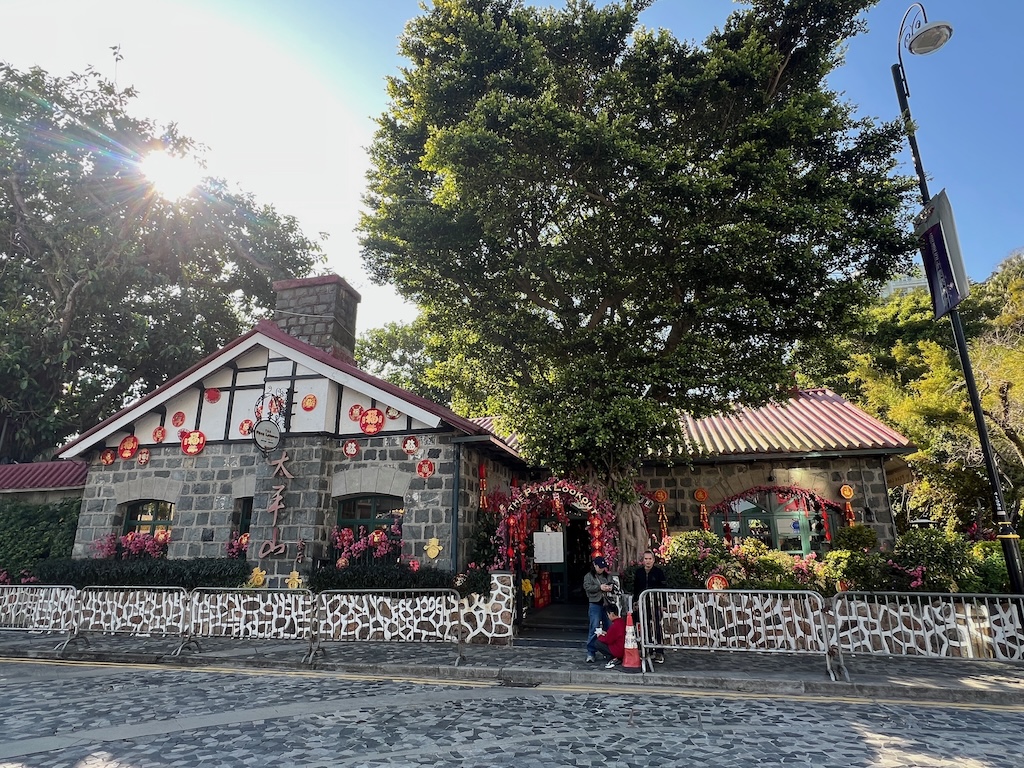
We picked a restaurant randomly for Restaurant Week and came across CulinArt 1862. We figured that it was part of the Towngas Avenue brand dining establishment because of its location and the 1862 reference. This has inspired me to look a bit deeper into Towngas 

The Jao Tsung-I Academy

The Jao Tsung-I Academy

The Jao Tsung-I Academy celebrates and memorializes the legendary life of Jao Tsung-I, a sinologist of many talents in arts and history. I took a walk at the venue and joined a public tour. The Life of Jao Tsung-I Jao Tsung-I was very accomplished in 

Autumn Excursion for Red Foliage in Shenzhen

Autumn Excursion for Red Foliage in Shenzhen

The bloggers and photographers in Hong Kong have been raving about the red foliage that has lined up the public parks in Shenzhen. I jumped on the bandwagon and visited two parks. I first visited the Sihai Park in Shekou, then headed over to the Lianhuashan Park in Futian. Let me introduce readers to Lianhuashan Park first.

The date of visit was January 10, 2025.

The Lianhuashan Park in Shenzhen

Lianhuashan Park, meaning the “Lotus Mountain,” acquired its name due to its location. Nestled within the seven hugging mountains shaped like a blooming lotus, the park features an exceedingly large land area with the substance and form of a well-manicured natural environ. Because I had the prior experience at Sihai Park, which was really not too nice in my opinion, the Lianhuashan Park was excellent, both in its own right and also as it is compared to the Sihai Park.

I took the subway and arrived at the northwestern gate of Lianhuashan Park. As soon as I entered the park, I felt this sense of openness and wholesomeness right away. The park features well-maintained, broad and paved pathways, with many beautiful park installations.

The trees were tall and grand, and you could see right away that this environment was a result of careful urban ecological planning. Trees of one kind lined whole sections of the park. Then you would see other species in the next section.

The pathway to the lake area was slightly inclined but it was a comfortable and pleasant walk. My heart leapt at the sight of the first red foliage.

The park was an incredible venue of respite from the now-fully-urbanized Shenzhen cityscape. I was amazed at how this park was serene – there were surely many people there, but the atmosphere was calm. The activities in this area were mostly strolling and fishing. The sights of cranes gliding elegantly across the lake caught the wonders of many bystanders.

I soon came into the lake area and enjoyed the scene of red foliage. People were fishing, and children ran around freely. Some people sat down simply to enjoy the apricity of January.

There are a whole lot more bald cypress in the Lianhuashan Park than the Sihai Park. The foliage in Lianhuashan Park are fuller, its colors brighter, and all around much more beautiful.

There are other features in the park, including a statue of Deng Xiaoping, who was being memorialized in this park for his contribution to the economic development of Shenzhen, but I did not see it.

This was the first time that I visited a park in Shenzhen. I was roiling in resentment after visiting the Sihai Park, and the Lianhuashan Park certainly redeemed the reputation of Shenzhen parks for me.

I exited the park via the Shimin Zhongxin (Citizens’ Center) subway exit.

The Sihai Park

On this day, I visited the Sihai Park first. It is a community park located in the Shekou area, which is close to the southwestern end of Shenzhen.

As a community park, the Sihai Park certainly features the activities and characteristics that are more down to earth than the Lianhuashan Park. At first I enjoyed the sight of people dancing and doing their taichi in the morning hours. This is a familiar scene and certainly a show of the park’s significance for the locals.

However, as I searched for the waterfront areas, I started hearing loud karaoke singing all along the park. Also, the park is clearly surrounded by the urban landscape of Shenzhen, and there was not a sense that you could find any kind of full escape from the city life in this park.

As to the red foliage, there are about two small sections. The bridge is photogenic, but the foliage was not as full and as colorful as that of the Lianhuashan Park. As my first visit to a Shenzhen park, the Sihai Park was not pleasant. I left the park in disappointment.

I debated and debated whether to see the Lianhuashan Park, but decided to give it a go. That turned out to be a good decision.


A Symphony of Colors –The Okochi-Sanso Villa in Arashiyama

A Symphony of Colors –The Okochi-Sanso Villa in Arashiyama

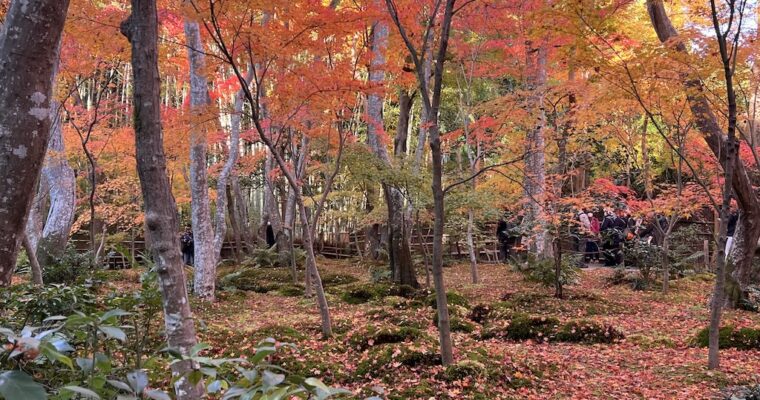
I had limited time in the day. My reserved table at the Unagiya Hirokawa Restaurant would be up at 2pm, and I spent too much time at the bamboo grove. After some debate, I decided that I would see the Okochi-Sanso Villa, despite initial doubts. 

A Symphony of Colors – The Tenryu-ji Temple in Arashiyama

A Symphony of Colors – The Tenryu-ji Temple in Arashiyama

If you have only limited time in Arashiyama, I highly recommend three sites to visit: the bamboo grove, the Tenryu-ji Temple and the Okochi-Sanso Villa. After walking the bamboo grove, I entered the Tenryu-ji Temple via the North Gate. One dominant theme of the temples 

A Symphony of Colors –Touring Arashiyama and Its Famous Bamboo Grove

A Symphony of Colors –Touring Arashiyama and Its Famous Bamboo Grove

In my original planning, I envisioned spending one full day in Arashiyama’s most famous sites, including the bamboo grove, the Tenryu-ji Temple, Jojakko-ji Temple, Nison-in Temple and the Okochi-Sanso Villa. Those I have done on the first day indeed (and more).
As it turned out, I visited Arashiyama on the next day again and saw the Otagi Nenbutsu-ji Temple, the Adashino Nenbutsu Temple, Gio-ji Temple and Danrin-ji Temple as well.
Some Preliminaries on Touring Arashiyama

In my humble opinion, Arashiyama (and Sagano) is worth two days of visit. As such, perhaps it is wise to stay one night in a hotel close to this area. That way, you might be able to see the bamboo grove very early in the morning, before enormous crowds (both foreigners and locals) flock to the area in the fall’s high season for sightseeing.

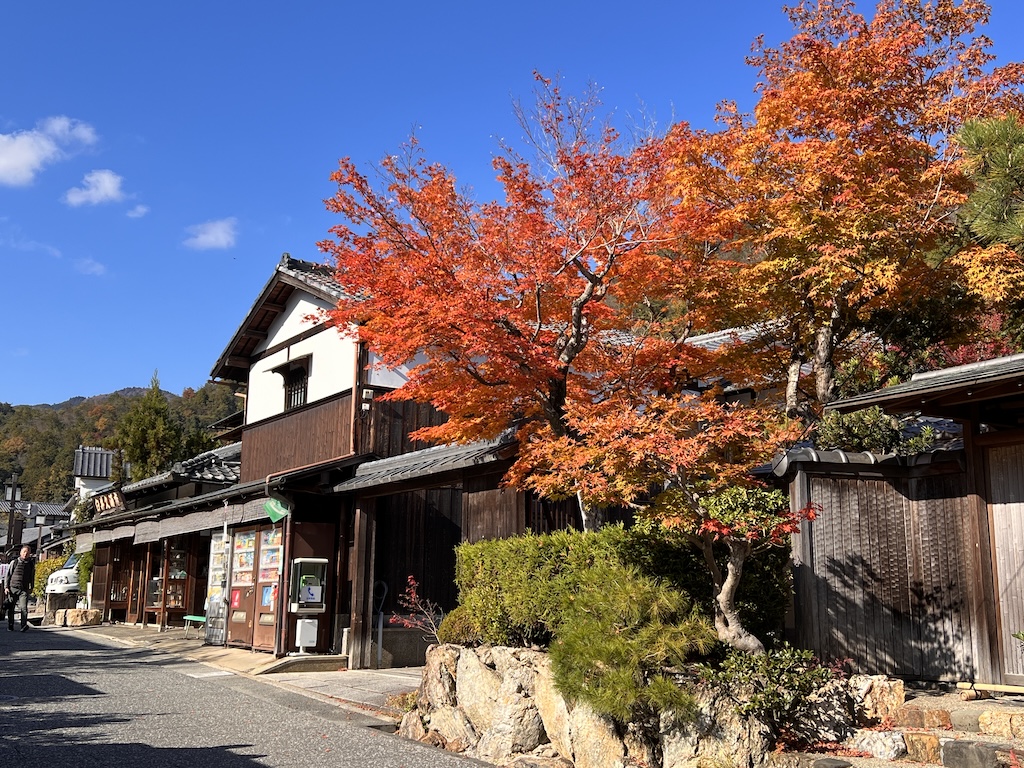
In the autumn, the mountains show beautiful, lush crimson foliage. On both days of my visit, I was blessed with generous sunshine, and as such I really enjoyed the scenery there. For nature lovers, I also recommend hiking from Mount Takao to Arashiyama. That was my original plan as well, but I had to scrap it due to work. In fact, I had not even managed to see the famous Togetsu-kyo Bridge.

Those who have not been to Kyoto might question my decision to visit Arashiyama for two days. This itinerary suggests seeing temple after temple. But the temples of Kyoto are unique and I mean it literally. Surely, there are thousands of them in one city alone, but each of them offers different sceneries at this time of the year, let alone the individual history and Buddhist practices in them. For the cultural and heritage tourist, Kyoto has so much to offer that one trip alone would not suffice.

There are a few notable must-do things in Arashiyama. Besides the temples that I did visit above, you can consider doing a hot springs session there (and perhaps book in advance). You can hike from Mount Takao to Arashiyama. For lunch, I made a booking at a unagi (grilled eel) specialist restaurant, Unagiya Hirokawa, about three weeks before my trip. Unagiya Hirokawa is by reservation only and they will turn away all walk-in.


Close to the Togetsu-kyo Bridge you will find the boat pier and a ride on the river cruise will show you the grand beauty of Kyoto’s nature. Similarly, there is the Sagano Scenic Train station close to the JR Saga Arashiyama Station, and it will drop you off quite close to the bamboo groves area.

Photo above: The scenic train will drop you off in the vicinity of the bamboo grove and the Okochi-Sanso Villa.

Finally, within the town area of Arashiyama (technically, Sagano) there is a very famous shop selling tofu and other soy products, a supplier for top tofu cuisine in Kyoto. Just on that business street alone there is an incredible array of light refreshments, coffee shops, proper restaurants, souvenirs and arts and crafts for you to try and see.

For a comprehensive list, please visit this website.

Day 1 in Arashiyama

Despite my best intentions, I was not able to arrive at Arashiyama’s bamboo grove before 8am. I had wanted to beat the crowd to the bamboo grove. It is one of the most-photographed sites in Kyoto, and I had wanted to see it without too many tourists. From Kyoto Station I took the JR line and got off at the JR Saga Arashiyama Station after a 20-minute ride.

It was a short walk to the bamboo grove. I arrived at 9am, perhaps good enough for a start. There were certainly tourists there but not too many.

Arashiyama, meaning “Storm Mountain,” is a picturesque, scenic area in the southwestern section of Kyoto. It is famous for both highest seasons for travelling, namely the springtime cherry blossom and the fall time autumn foliage. The Hozu River runs on the east-west direction and separates what is technically Arashiyama in the southern mountains with Sagano in the north.

For navigating in the area, Google Map will do the job. My suggestion is certainly to see the bamboo groves first. As you go through the rather long way of the bamboo-lined path (about half a kilometer), you will pass by the Tenryu-ji Temple and the Okochi-Sanso Villa toward the end.

Bamboo Grove

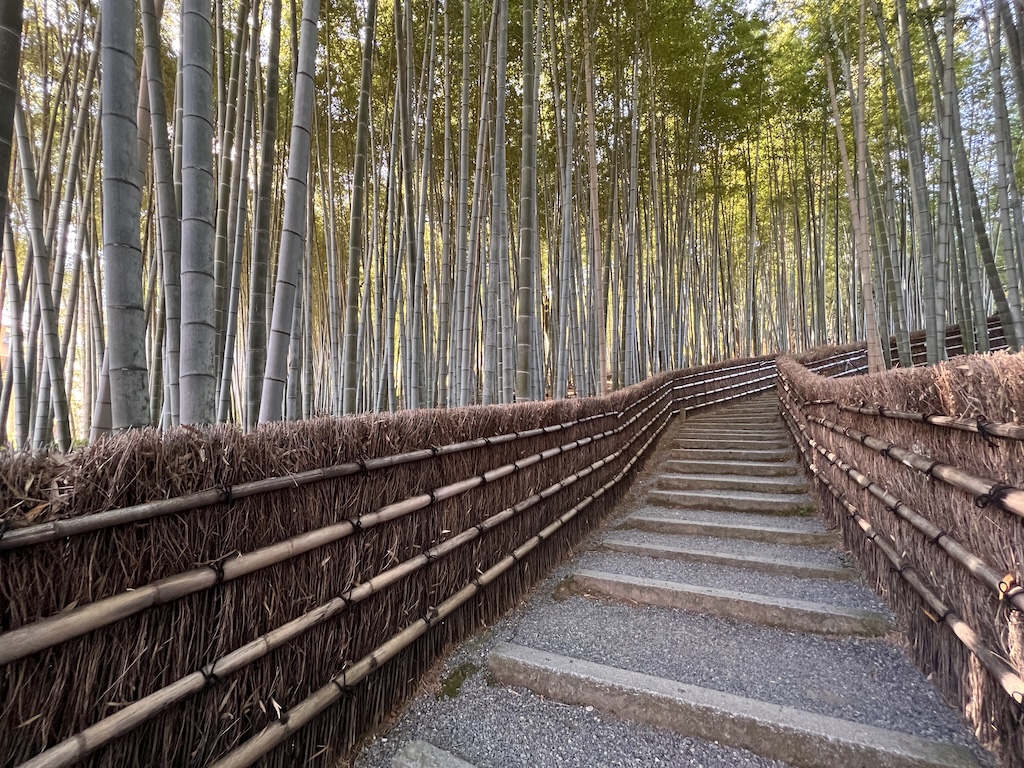
One reminder to travelers is that the section of the bamboo grove that is the most-photographed actually takes a little while to get to. When you enter the pathway coming from the JR Station, you may think that the bamboo grove has ended, and the first section did not look so pretty.

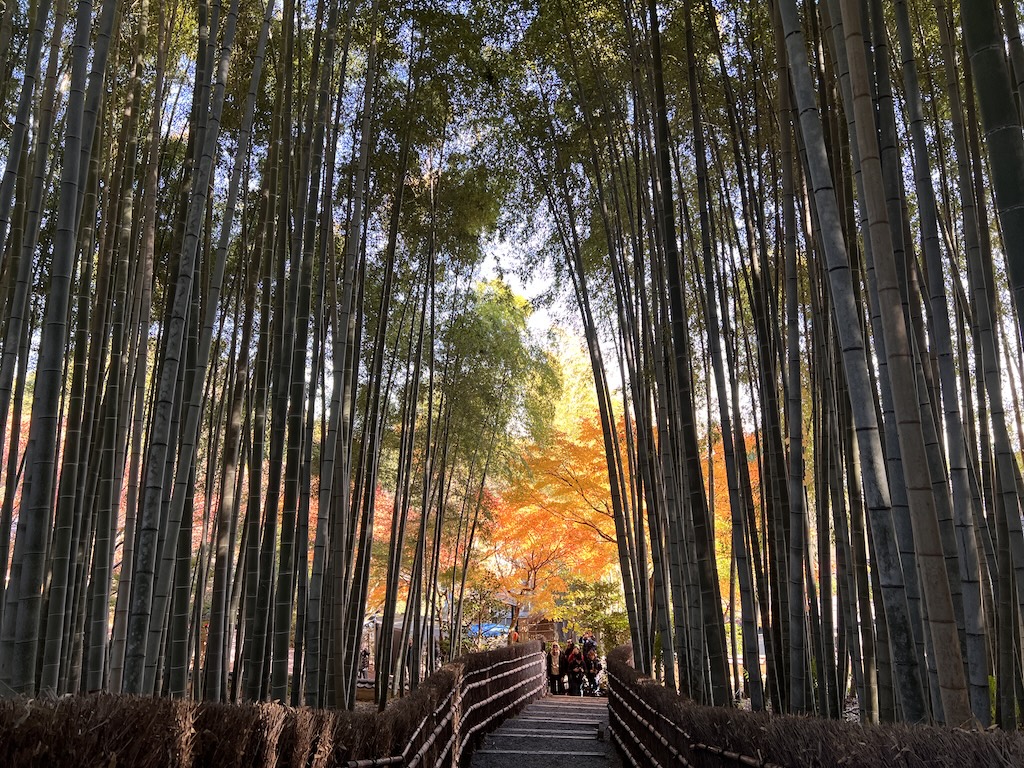
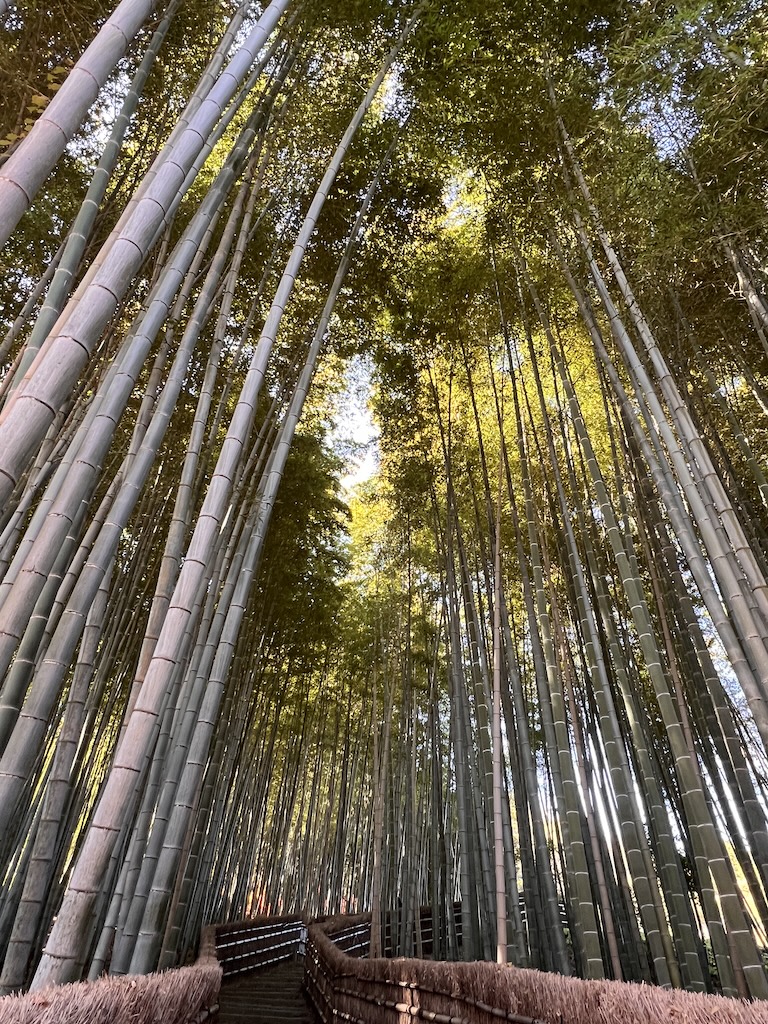
Something in my heart edged me to go forward, despite the initial disappointment. My instincts were right. The most-photographed section came later, and it was a whole lot more beautiful. Featuring a grayish-green panel of enormously tall bamboo stilts, with thatched lining at the base. The grove was dense, full and vibrant. That is where you can take instgrammable pictures.

As one of the most-photographed sites in Kyoto, the bamboo groves must come with some sort of story. Inside Kyoto gives a very good account of why such a beautiful pathway lined with thousands of bamboo is in this area. The quick answer is, these bamboo groves served mostly aesthetic purposes originally. During the Heian period, Arashiyama was a very popular location for imperial and noble villas. The bamboo groves took up a much larger area then, and they featured prominently in the gardens of these villas. During the Edo period, bamboo was a raw material for Japanese crafts, and bamboo shoots were a common ingredient in Japanese cuisine. This combination of factors has resulted in an extremely large area of bamboo in Arashiyama.

The bamboo grove that we see now is already a much smaller version compared to what it was in the classic era. In 1967, the government took official actions to protect the bamboo groves.

If you did not manage to visit the bamboo grove at a photograph-friendly time because of the overwhelming presence of tourists, there is an alternative. There is a much shorter bamboo alley in the Adashino Nenbutsu-ji Temple too. Significantly less number of tourists visit the Adashino Nenbutsu-ji Temple, and you will be able to enjoy a near-solitude in that bamboo alley.

Photo above: The bamboo path at the Adashino Nenbutsu-ji Temple

Sources

Insidekyoto.com, Arashiyama Bamboo Grove Walking Tour.

Japan-guide.com, Arashiyama and Sagano.

A Symphony of Colors –The Yasaka-jinja Shrine and Gion

A Symphony of Colors –The Yasaka-jinja Shrine and Gion

From the Kiyomizu-dera Temple I headed toward the direction of the Yasaka-jinja Shrine. I was quite tired, as in this day I have visited the Nijo Castle and have had to bear the cold at the Kiyomizu-dera Temple. I pressed on, however, as I wanted 

A Symphony of Colors –The Kiyomizu-dera Temple at Night

A Symphony of Colors –The Kiyomizu-dera Temple at Night

The adventurous lunch of the day was at a convenience store. I have long heard that the convenience stores of Japan serve up wonderful egg salad sando’s. And it certainly lived up to its good name. From the 7-Eleven, going on Matsubara-dori, was a gentle 

The Central Market

The Central Market

Along the busy Queen’s Road Central stands a market that has a long history serving the daily needs of Central residents since the beginning of Hong Kong as a British colony. First opened in 1842, the year after the British formally began their colonial administration of Hong Kong, the Central Market has gone through a few constructed buildings as a market place.

Central Market: A Brief History

In its very inception, the Central Market stood on Queen’s Road Central, then the throughway that ran the east-west direction near the coastline of Hong Kong Island’s northern shore. The natural inference is that this location would be ideal for the sake of logistics.

The Central Market was always part of Victoria City, but certainly the settlement area for the Chinese residents, at the city’s western end. It is believed that the very first Central Market was built to cater to the needs of the influx of Chinese population from Guangdong at that time.

In 1858, the second generation Central Market building was reconstructed to once again answer the demand for marketplaces due to an influx of Chinese population. The market was officially named Central Market then, and its boundary was demarcated with the bordering Jubilee Street and Queen Victoria Street.

Beginning in 1889, the Central Market underwent another reconstruction. The third generation Central Market was a red brick building with granite finish. It also had two stories and two blocks, with a central avenue that separated them.

The modernization of the Central Market continued well into the 20th century. In 1939, the fourth generation Central Market came into being, in the architectural style of the Streamline Moderne that served the functional purposes of the market. The building accommodated 250 market stalls with an open atrium.

The Central Market had witnessed more than a century of changes in this location of Hong Kong’s business district. Having gone through a few phases of reinvention, it finally ceased in its historic role as a wet market in 2003. In 2002, the Hong Kong Government had put the market on the Land Application List for 2004. That meant that the original plan for this space was the demolishment of the market building for new uses. For years, the Central Market lied vacant awaiting the final determination of its fate.

In 2005, a group of stakeholders, including architects, district councils and some important persons in the society, called upon the government to preserve the Central Market. They cited the reason that the Central Market was the only surviving building in Hong Kong that represented the Bauhaus architectural style. There was a bit of controversy then, but in 2009, the government finally included the Central Market into its heritage preservation program, “Conserving Central.”

In 2021, the Hong Kong Government finally finished the revitalization of the Central Market and it reopened for business, although certainly in a format that meets the current standards of higher-end leisure and dining.

The Historical Significance of the Central Market in the Early Colonial Times


Despite it being a marketplace for the early merchants and farmers of Hong Kong, the Central Market stood for a historical significance far beyond being a place of business for the Chinese community living in the “Chinese section” of Victoria City. A number of academic articles about the history of the Central Market note a common observation. The Central Market was a perfect microcosm that reflected the complicated relationships between the colonial government of Hong Kong, the business communities (both Chinese and foreign) that represented the money, and the lives of the common shopkeepers that simply wanted to make a living.

In 1842, the Central Market began its first page in history with the support by then Colonial Secretary Colonel George Malcolm. In its very beginning, the colonial government owned the central market and collected a standard rate of rent from the stalls. A certain man named Hwei Aqui was the superintendent of the market.

However, in 1844, the government wished to turn a profit from the market. The decision was to auction the right to the market to the highest bidder, who would hold the license for a fixed term to run the market. He would be allowed to charge the stalls at whatever rate that he deemed fit. The owner of the market had the obligation to pay the government rent on an annual basis, but he also had the obligation to maintain the physical infrastructure of the market and the roads. As it turned out, Hwei Aqui won the bid. Perhaps not too surprisingly, the rent for the market experienced significant hikes very quickly. Hwei Aqui was soon in debt as he became too ambitious trying to develop the property in the land between Queen’s Road Central and the shoreline.

Before Hwei Aqui’s death in 1846, he entered into a number of complicated shareholder arrangements, debt instruments and partnerships to maintain the business at Central Market and the corresponding property development. In his dealing with fellow Chinese businessmen and the colonial government arose many disputes that exposed the extortionary practices of the colonial government officials and scandals involving foreigners. Lawsuits and media expose about the corruption troubled the Central Market within its first decade of existence.

Until 1847, the Chinese people of Hong Kong monopolized the market business. But eventually the colonial government opened up the licensing mechanism for application by foreign and Chinese merchants alike. The wet market was very much a Chinese way to acquire daily necessities, but both foreigners and Chinese businessmen perceived the profitability of being a market proprietor.

A Revitalized Space for Leisure

The Central Market now is populated with trendy establishments, be they food, coffee, bar, souvenirs or any kind of shop, featuring local or foreign varieties in what they sell. The venue offers an outdoor seating area, which would have been the open atrium of the 4th generation Central Market. On good days they are the perfect sit-down ambience for coffee.

Needless to say, the dramas of business and government dealings under Hwei Aqui’s early lease of the market are but buried in esoteric history journals. Perhaps what remains of the Central Market now are merely touches of nostalgia. The original staircases are preserved. There are also signages here and there that bear a significance that only a keen eye for historic detail would be able to notice. On the underground floor, a section with exhibits introduces a brief history of the Central Market, for those that are indeed interested in the heritage that it represents. There are stalls set up that purport to convey just a sense of the past, reenacting scenes of the fresh foods that were sold in this market.

Sources

Descriptions on site at the Central market

The Wikipedia on the Central Market.

Dafydd Emrys Evans, The Origins of Hong Kong’s Central Market and the Tarrant Affair, 12 J. of the Hong Kong Branch of the Royal Asiatic Society 150 (1972).

The Central Market website.

The Jardine Gate at the Beas River Country Club of the Hong Kong Jockey Club

The Jardine Gate at the Beas River Country Club of the Hong Kong Jockey Club

The day was bright and perfect for al fresco dining. I joined my family in a casual lunch at the Beas River Country Club of the Hong Kong Jockey Club in Sheung Shui. I lived close, so I walked about 40 minutes to arrive at