Blog

Ma Tso Lung – Fish Ponds in Hong Kong’s Hinterland

Ma Tso Lung – Fish Ponds in Hong Kong’s Hinterland

Views of the fish ponds at Ma Tso Lung has become a hot spot for photo-taking in recent years, especially for sunset photos.  This area of the New Territories used to be restricted border area.  In 2013, the Hong Kong Government lifted the border restrictions 

Billow at the Little Egret

Billow at the Little Egret

When I was young, I was always fascinated by a beautiful natural lake that I saw when the train passed between the University and Tai Po Market stations.  Back then, it was simply a lake with a lone rock in its middle.  This scenery in 

A Delightful Short Walk at the Ngau Wu Reservoir

A Delightful Short Walk at the Ngau Wu Reservoir

The Ngau Wu Reservoir

The Ngau Wu Reservoir is an unusual reservoir in Hong Kong.  It is not a government-run reservoir.  Built at mid-stream of the Ngau Wu Stream, it wells fresh water flowing from Ngau Ngak Shan (the Hunch Backs).

The reservoir served the water needs of the Wu Kai Sha Children’s Garden (which was an orphanage) since 1963.  The Children’s Garden ceased operation around the 1970s.  Then the former site of the orphanage became the Wu Kai Sha Youth Village.  One special feature, perhaps unique amongst Hong Kong’s water reservation facilities, is the V- shaped dam of the Ngau Wu Reservoir.

The reservoir is very small and it takes just one minute to walk (carefully) along the main dam.  It is possible that even today the reservoir supplies water to the Wu Kai Sha Youth Village.

Ngau Ngak Shan, on the other hand, is the lower peak of Ma On Shan at a height of 677 metres.  The Ngau Wu Reservoir lies at the low-to-mid level of the mountain, with Ngau Ngak Shan, standing tall and grand, on its back.  There are well-known trails from Tiu Shau Ngam that lead hikers up to its peak and then the highest summit of Ma On Shan, but they are of the most difficult level.  A short and easy walk to the Ngau Wu Reservoir would have to do for me, as I went alone on this really hot summer day.  I spent a little more than two hours at Ngau Wu Reservoir.

How to Get There

There are a few sites in this area that are worth visiting.  First of all, let’s head to the mountain from civilisation.  At the Wu Kai Sha MTR station, take Exit B and walk toward Lee On Estate, on Sha On Street.  Please do not enter Lee On Estate.  At this point, which is right before you head into Lee On Estate, there is a small set of stairs down to a well-paved road.
Walk on the well-paved road all the way toward the very end.  You will have climbed a few sets of stairs up, right beneath the highway.  At the T intersection, make a right on the paved road, on a gentle incline.

Keep on going, and soon you will notice a graveyard for the indigenous villagers of the Wu Kai Sha Village.  Thereafter, you will see a distinct section of the road with tall trees lining on two sides.

Perhaps within three to five minutes, keep watching to your left.  There is a concrete structure, and the entrance to the mountainous path is right via this road by the concrete structure.  In Chinese it says “up the mountain.”

Follow this path, and soon you will come across a crossroads.  There are two metal racks on your left.

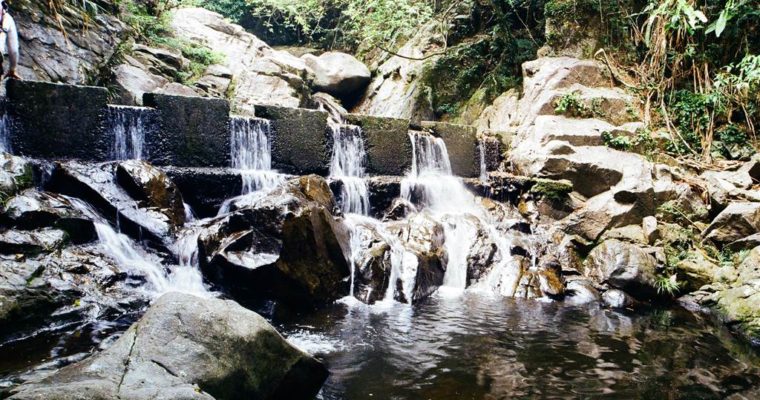
I first explored the path on the left, and it leads you to a man-made, very small pool of water.  The steps up by the pool will lead you up the Ngau Wu Stream.  Because we have seen quite a stretch of sunny days, the water was not voluminous.  Yet the small stream was a pleasant rest point.

After visiting the man-made pool, I went back to the crossroads with the metal racks.  I then took the path to the right, and went up to the Ngau Wu Reservoir.

When you see this crossroads, take the path on the left.  This will take you to the main dam of the Ngau Wu Reservoir.

A photograph or two will do for this section of the sightseeing.

Head back to the beginning of the dam, and cross over the dam at this point.

It leads you to the small stretch of rocky shore that you see from a distance at the main dam.  From this point, you see the tall buildings of Ma On Shan over the Ngau Wu Reservoir.

There was not enough water on this day, therefore the small “waterfall” did not even create a well of water at the rocky shore.  As such, the shore was mostly dry.

Now head back to the main dam, climb back up and head over onto the path on your left.

At the next crossroads, take the path on your left and you will be heading to the small dam of the Ngau Wu Reservoir, with a small natural pool with water crystal clear.  The path on your right would take you even further up-stream, but I did not do that this time.

The views are exceptional there as well, and I spent quite a bit of time sunbathing as I dipped my feet into the cool of the water.

Interesting Sights

At both the man-made pool and the natural pool at the small dam, I observed villagers collecting water from the up-streams.  I thought that was very interesting.  An older lady brought a few heavy-duty empty bottles (as in 5-litre bottles) with her.  I asked her if she was indeed bringing all those back to civilization, and she said yes, it is not too much work for her.

At the man-made pool I saw an old man bathing there, and surely both pools are suitable for bathing.  The water was so clear, and the scenery so serene, I thought I would come back with my swimsuit as well.

Gentle Reminders

The paths are mostly unpaved once you ascend onto the mountain.  They are well-trodden roads, but quite rocky throughout.  If not careful, you might easily sprain your ankle.  The inclines are gentle and the path was generously shaded throughout, however, therefore do bring enough water and it should be an easy afternoon outing, perhaps suitable for older children as well.

Sources

Most of the historical descriptions on this entry came from the Wikipedia and Oasistrek.

The Sai Wan Swimming Shed

The Sai Wan Swimming Shed

The Sai Wan Swimming Shed has become a much sought-after spot for photo-taking in recent years.  As it faces the northwestern end of Hong Kong Island, the location is perfect for sunset photos.  Many couples find it a beautiful spot for dating.  I was curious 

Like Greece – The Chung Hom Kok Battery

Like Greece – The Chung Hom Kok Battery

There is a reason why I ran into three couples taking their wedding pictures on my visit to the Chung Hom Kok Battery.  It is very much like Greece. Chung Hom Kok as a Structure of Defence The half-dome structure is beautiful, as it is 

Yuen Long’s Old Market (The Qing Dynasty Street)

Yuen Long’s Old Market (The Qing Dynasty Street)

Yuen Long today is a thriving town in northwestern New Territories, mostly known for its great food.  It is also an area heavily populated with indigenous villages.  As such, Yuen Long had a long history of development in Hong Kong, going way back to the Song Dynasty.

It only came to my attention recently that Yuen Long has an Old Market area, which spans the three streets of Cheung Shing Street, Lee Yick Street and Wine Street.  I was intrigued, as the local tour agencies call it the “Qing Dynasty Street.”  I paid a short visit and read up on its history.

History of the Old Market

During the Qing Dynasty, the Yuen Long Old Market was the heart of economic activities.  Throughout the Qing Dynasty, it was the major marketplace in all of Hong Kong.  Due to the imperial edict of coastal evacuation, the market stopped running.  During the 8th year of the Kangxi Reign (1699), the jinshi[i] village gentry Tang Man-wai of Kam Tin (then known as Shum Tin) submitted a formal request to the Qing Court to revive the Yuen Long region’s economy.  The Yuen Long Old Market was a result of this initiative.  The Tang’s re-established the market in the general area of Nam Bin Wai.

This geographical location was a very good choice for a market.  The land lied in the northwestern part of Hong Kong, bordered the southern shore of the Shenzhen River west, where the Shan Pui River and Kam Tin River intersected.  This enabled the people of the neighborhood villages, including Ping Shan, Kam Tin, and Shap Pat Heung to arrive by boat.  As such, the market had quickly garnered the presence of vendors selling all kinds of necessities.  From daily veggies to letter-writing services, the Yuen Long Old Market had plenty to offer.

“Hui” – A Distinct Idea of a Marketplace

In Cantonese, the Yuen Long Old Market is the Yuen Long “Kau Hui” (“kau” meaning old, and “hui” meaning market).  Yet the “hui” has a nuanced difference from the more commonly used word “shi,” which, for the lack of an alternative word in English, also means market.

At the Yuen Long Old Market’s new beginning, it was a “hui” consisting of temporary vendors selling their goods in make-shift stalls.  They began the day early at dawn, and they would wrap up the day’s trade after noon.  The “hui” elicits the idea of mobility, versus the more stable “shi.”  Craftsmen of all kinds would offer one-off services, such as barbers, fortune tellers, or letter-writers.

As opposed to “shi,” “hui” refers to a kind of marketplace that has more downtime.  On certain days when the “hui” opens for business, it draws vendors from all walks of life.  Yet in any given month the “hui” would open for only about ten days or so.  The “shi,” on the other hand, is more permanent, although perhaps operating on a smaller scale.  As times progressed, however, the distinction between “hui” and “shi” slowly disappeared.  The Cantonese language no longer distinguishes between the two.  A marketplace, in old Cantonese, is simply known as “hui shi.”

As business continued to develop, people built and operated standard stores in the Yuen Long Old Market.  The earlier establishments were grocers.  Then further development invited the presence of food and beverages, tools, services and even entertainment industries.  It did become a one-stop market that met all of people’s daily and lifestyle needs.

Management of Yuen Long’s Old Market

Tang Man-wai set up the Kwong Yu Tong to handle the day-to-day management of the Old Market.  As it was common to other marketplaces in the New Territories, the commission system (gong ching) ensured a steady stream of profits for the market owners.  At each transaction, both buyers and sellers share equally the commission, a rate that depended on the quantity of the goods changing hands.  Having won a bidding process, the holder of “ching” can collect these commissions for the period of one year typically.  Then the holder of “ching” would pay a rental fee to Kwong Yu Tong.  Kwong Yu Tong used these funds for maintenance and community development.

Because Tang Man-wai’s family monopolized this space, the commission system was rife with corruption.  And this feature could have contributed to the downfall of the Old Market, which had a glorious 240 years of operation.

The Rise of Yuen Long’s New Market

The parts of Yuen Long bustling with economic activities today are actually the Yuen Long New Market (“san hui.”)  During the early 20th century, the Yuen Long Chung riverbeds were clogged, causing significant inconvenience for transport by boats.  The New Market also came about due to some villagers’ discontent with the long-time monopoly of land rights and profits in the Old Market by the Tang Man-wai family.

In 1915, Yuen Long’s New Market completed its basic structures, made possible by a pooling of funds from a number of village leaders.  The Hop Yick Company was responsible for the management of the New Market.[ii]  The features of the market included wide-open space for store fronts and a plaza for street stalls.  Most importantly, the owners established an independent commission system that ensured fair trade.  The New Market became very popular, causing the Old Market to gradually phase out in significance.

The Visit

I exited the Yuen Long MTR Station at Exit B.  Having passed the Nam Bin Wai village (see picture below), I walked on and passed by the thriving banyan tree.  That is the way to Cheung Shing Street, the main street that runs through the Old Market area.

I took a leisurely walk within this area and it took me about 30-40 minutes to finish the walk.

The Heritage Sites of Yuen Long Old Market

Most of the old buildings of the Qing Dynasty have now been rebuilt into modern homes.  Some heritage still remains, however.  I took a quick tour of the area and saw three main structures that are still here today.

The Po Yuen Pawn

The Po Yuen Pawn is the oldest pawn site in Hong Kong.  It was built during the mid to late 18th century by a descendant of the Tang clan, Tang Lim-ming.  The blue brick structure stands beautifully today, unfazed by the currents of history.

The Po Yuen Pawn served as the vendors’ go-to store for cash flow.  They would pawn a piece of valuable in exchange for cash.  When they have made their rounds trading at the market, and have earned money, they would redeem the pawned good.

The Po Yuen Pawn shut down during the Japanese Occupation of the 1940s, and remains closed today.

One can only imagine the kind of big money that used to come and go at this type of establishment.

Tai Wong Temple

The Tai Wong Temple has stood its time of 340 years since the inception of the Yuen Long Old Market.  It is the oldest building in the Old Market area.  The resident gods are Hong Shing and Hau Wong.

Yi Tai Temple

The Yi Tai Temple has had at least 300 years of history.  The resident gods are Pak Tai and Kwan Tai.  They were revered as the gods of commerce.

These temples served more than religious purposes.  As a social and community space, they were the venues for dispute resolution and policy-making by the village leaders.

The Old Market Today

Although most of the buildings in this area are modern homes, some do retain an old-fashioned feel.  They were clearly 20th century buildings, which by now can be deemed historic.  These are the views of the Old Market area now.

Sources

All historical descriptions of Yuen Long’s Old Market came from Society of Hong Kong History, Hong Kong History in Historical Artefacts (Chin. 2014) at 67-74.

[i] The title “jinshi” is given to those who has past the final level of Qing Dynasty’s imperial civilian examination.  As such, Tang Man-wai was a reputable village gentry, in addition to being a member of a prominent Tang indigenous family in Yuen Long then.

[ii] The Wikipedia on Yuen Long Hui.

A Stumble upon the Sam Cha Cave

A Stumble upon the Sam Cha Cave

The original plan of the day was to hike the general areas of Hong Kong east, namely, Mount Butler, Mount Parker or the Quarry Pass area.  We began at Nam Fung Sun Tsuen but that was the last thing we knew.  Some wrong ways here 

The Sai Wan Battery

The Sai Wan Battery

Pre World War II History The British built the Sai Wan Battery early during the colonial times.   Originally, they built only the redoubt up on the hilltop in 1895.  Three years later, the British military added two 6-inch gun platform as well, and construction completed 

Boats of Nostalgia – The Ferry to Sai Wan Ho from Kwun Tong

Boats of Nostalgia – The Ferry to Sai Wan Ho from Kwun Tong

It could not have been a better weather for a ride on the sea.  I was joining a friend for lunch at Sai Wan Ho.  We planned on meeting at Soho East, the well-known restaurant strip right next to the Sai Wan Ho Pier.  It was out of convenience that I decided to take the ferry, and it turned out to be a wonderful decision.

I took a bus to Kwun Tong and got off at Millennium City.  I walked for ten minutes toward the sea and arrived at the Kwun Tong Public Pier.  Its humility came as a surprise to me.  I did not know what to expect, to begin with, but in the back of my mind I had the image of the swanky pier establishments in Central.  Surely, someone thought that the selling point of this pier was its humble, simple elegance.  On one of the main pillars there are printed words saying “boats of nostalgia.”

The ferry schedule is simple.  In each hour of operation, the ferry comes twice, on the 18th and 48th minute.  True to its word, the ferry to Sai Wan Ho came at 11:48am.  When it arrived, I understood immediately the meaning of “boats of nostalgia.”

The ferry was clown-themed.  It came with a very festive décor, perhaps in an outmoded way.  The operator is Coral Sea, a company that I have not heard of.  But the wooden ferry in its bright colors made me smile.  I went on board and saw a clown, smiling ear-to-ear, sitting in the middle of the boat.  It was as much a surprise as it was comical, “ah-ha, so these are clown colors!”

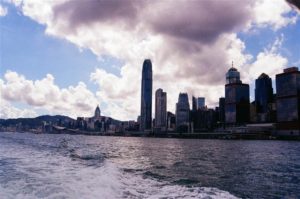
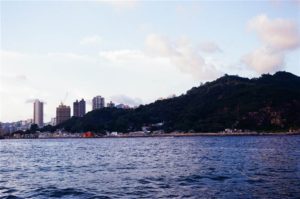
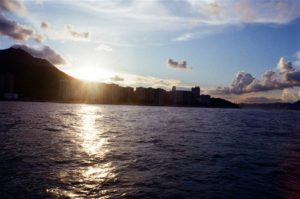
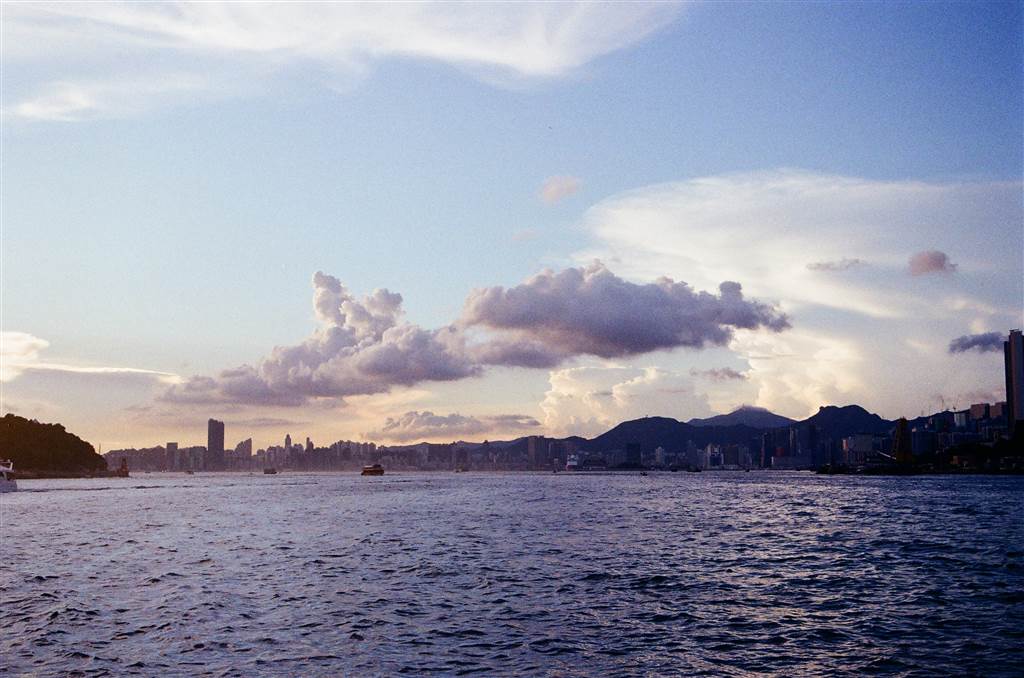
I took the stairs to the upper deck.  The ferry headed right across the eastern entry to the Victoria Harbour, the Lei Yue Mun Pass.  The first landmark that came into sight was the former runway of the Kai Tak Airport.  Then came open, wide open, views of the Victoria Harbour.  All of Hong Kong’s skyline, from the eastern corridor to the very western end, and on both sides of the harbour, reeled by.

Very frankly, I did not foresee that a boat ride could so refreshing.  It really brightened up the day for me.  I told my friend that I would be going for lunch with her again.  And yes, I would do this again, and again.

From Chuen Lung Village Down to Shing Mun Catchwater

From Chuen Lung Village Down to Shing Mun Catchwater

Originally we were going to hike the Lung Mun Country Trail from Chuen Lung Village to the Shing Mun Reservoir.  However, after a mad good time at dim sum at the village, we were left with little time for the intended trail.  Therefore we changed