Blog

An Easy Half-Day Trip in Yim Tin Tsai

An Easy Half-Day Trip in Yim Tin Tsai

I have plans to venture out to all the walkable islands lying in Sai Kung’s eastern waters. Since the weather turned somewhat cooler, I have visited the Sharp Island twice, once to hike and another time to visit its Kiu Tau Islet at low tide. 

Ubiquitously Uzbekistan – The Shah-I-Zinda, Crown Jewel of Samarkand

Ubiquitously Uzbekistan – The Shah-I-Zinda, Crown Jewel of Samarkand

We took a quick lunch at the Siab Bazaar and then headed toward the Shah-I-Zinda. On our way, we passed by the Hazrati Hizr Mosque. The Hazrati Hizr Mosque The Hazrati Hizr Mosque was built in 1823. Although as compared to the myriad other ancient 

Ubiquitously Uzbekistan – Ulug Bek’s Legacy

Ubiquitously Uzbekistan – Ulug Bek’s Legacy

We woke up to a rainy morning in Samarkand. I had my Uzbek breakfast early in the morning and watched the rain as I ate. The weather was cool, perhaps in the low 20’s. We were going to see the Sha-I-Zinda that day, as the climax of our stay in Samarkand. It was also our very last full day in Samarkand.

I sat in the courtyard in a gloomy mood wondering if we would be able to make it out at all, given this rain.

Surely, we had not expected this rain. Originally, we had a few things in mind. We first wanted to see some lesser-known sites within the city. My suggestion was to visit the so-called “European Town.” There is a Russian orthodox church in that area. Since I did not get to see the biggest cathedral in Tashkent, seeing some Christian presence in Samarkand would be a nice change of scenery for us.

Then I heard that the Ulug Bek Observatory was worth a visit. My friend said that the rain would stop soon, and the afternoon would greet us with sunshine. I was not as hopeful as she was, but indeed that has been the pattern for the weather in Uzbekistan as far as we could observe in our first few days there.

We decided to head out in the very late morning. There was still quite a bit of a drizzle, but we could not wait further.

The Church of St. Alexius Metropolitan of Moscow

According to Sophie Ibbotson, “to the west of the Timurid city is the Russian quarter, also known as the European Town, laid out at the end of the 19th century. It has been listed as a World Heritage Site by UNESCO since 2001; nevertheless, it is under threat from developers abetted by the city authorities.”

In terms of European architecture, we could not tell if any of the buildings we saw were in fact historic buildings, or simply structures that looked different from typical modern Uzbek buildings or just buildings constructed with a European front without a history of European presence.

Surely, however, we did find the Church of St. Alexius Metropolitan of Moscow, a street away from the tree-lined University Boulevard on Abdurahmon Jomiy Street.

We entered via the side porch. It shows a pointed dark green top with two columns in salmon pink. That is an unusual color for any church in my opinion.

We went on Easter Sunday (on the Gregorian calendar). There was no service, but the church was open and we could tour inside. There were nice stained glass windows throughout and the space was filled with peace. The ceiling was lined with white toned tiles with blue patterns. Many of the relics inside the church showed a golden tone.
As an orthodox church it felt markedly different from the many, many mosques that we visited in Uzbekistan. Its presence does show that Uzbekistan is a country of diversity, and that it continues to accommodate many kinds of faith.

I was not able to find established sources about the history of this church, but on Tripadvisor a very knowledgeable visitor explained some of this church’s history:

The church construction in 1912 was supervised by architect F Verzhbitsky and a military engineer, Smirnov, from St. Petersburg. It was intended to be a military church for the Russian garrison in Samarkand. During Soviet times the bell tower was removed and upper chapel section demolished. The church underwent major reconstruction after being returned to the community in 1992. The temple is dedicated to Saint Alexius who ruled Moscow for a short period as advisor to the young Czar, and was appointed bishop of Moscow in 1354. St. Alexius is one of six churches in Samarkand.

The Chinese Garden of Samarkand

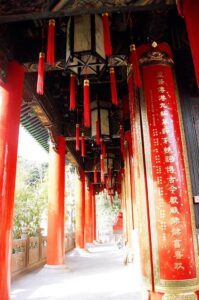
Before reaching the Church of St. Alexius Metropolitan of Moscow, we passed by the Chinese Garden, which clearly pays tribute to Confucius and the teachings that he advocated in the Analects.

The gateway, the bronze urns, and the covered pavilion corridor all seemed authentic. It could have been just about any park in China. We found it quite amazing.

After a tour in this part of the town, we took a taxi and arrived at the Ulug Bek Observatory.

The Ulug Bek Observatory

Ulug Bek constructed the Ulug Bek Observatory during the 1420s. It was destroyed in 1449. A Russian scientist V. K. Vyatkin studied the archived documents about the observatory. He excavated the site in 1908, and since 1948 the preserved ruins of the Observatory have been open for visits.

As a heritage site, the Ulug Bek Observatory offers only a quick one-minute look. Only the trench was excavated and preserved, and that was amazing in its own right. The original Observatory consisted of three stories, the upper two of which were for the purpose of observing the celestial bodies. The Complex Museum of Mirzo Ulugbek offers perhaps the most comprehensive historic description of his life and contributions in science. Therefore it is worth a visit.

The Astronomer King

Ulug Bek, meaning the “Grand Duke,” was born Muhammad Taragay in 1394 to Shah Rukh, who is the son of Amir Timur. Amir Timur saw Ulug Bek’s promise at a young age and he groomed Ulug Bek himself. His father gave him the governance of the kingdom’s capital at Samarkand, while his father ruled Persia from Herat.

The most notable quality of Ulug Bek was his learned nature. He was an established scientist in his lifetime, especially in the field of astronomy.

Endearingly known as the “astronomer king,” Ulug Bek has made significant contribution by the publication of his Zij table. The Zij table “is an astronomical table that is made up of numerical tables and explanations that allow astronomers to compute any problems they encounter. It should provide enough information that they can understand how to measure time and how to compute the positions of planets and stars.” (The Wikipedia on the Ulug Beg Observatory). According to Calum Macleod, Ulug Bek “plotted the coordinates of 1,018 stars … devised rules for predicting eclipses and measured stellar year to within one minute of modern electronic calculations.”

The Zij Table and generally Ulug Bek’s work in astronomy has had worldwide influence. From the east to the west, scholars in China, Korea, Turkey and Europe learned and debated his work, and made additional commentaries.

Photos: the trench in the Ulug Bek Observatory is the only original ruins that remains

His scholarly efforts have ushered in the cultural renaissance during the Timurid dynasty. As such, Ulug Bek’s legacy is reflected first and foremost in the institutes of learning. The Ulug Bek Madrassa of Samarkand in the Registan being one of the major constructions that he undertook, he was also the education patron for the scientific learning that took place there. Students seeking admissions in the Ulug Bek Madrassa in Samarkand had to first pass an examination. Ulug Bek himself personally participated in this examination process. He has furthermore built the Ulug Bek Madrassa in Bukhara, for which I will write about in a later entry.

As a statesman, Ulug Bek did also engage in military expeditions to secure the borders of the Timurid Dynasty. In 1425, he led troops to Mongolia and defeated the Mongolian troops led by Amir Ibrokhim and Jakhonshoh. However, he was generally not able to secure a strong rule as the king. In 1449, his son Abd al-Latif seized him after defeating him in a few battles. Ulug Bek was eventually beheaded by this same son when he was purportedly sent to Mecca for a pilgrimage. The Ulug Bek Observatory, as his major legacy, met the same fate of near-complete destruction.

Ulug Bek’s burial is also at the Gur-I-Amir in Samarkand, a dynastic burial for the Timurids that he himself oversaw.

Sources

Sophie Ibbotson, Uzbekistan, Bradt Travel Guide (2020).

Calum Macleod, Uzbekistan: the Golden Road to Samarkand (2014).

User comment on Tripadvisor.com on the Church of St. Alexius Metropolitan of Moscow.

Descriptions on site at the Complex Museum of Mirzo Ulugbek.

The Wikipedia on Ulug Beg.

The Wikipedia on the Ulug Beg Observatory.

Ubiquitously Uzbekistan – A Chanced Encounter with Czech Republic

Ubiquitously Uzbekistan – A Chanced Encounter with Czech Republic

In our first night at the Bahodir B&B, we were quite disturbed by the group singing that went well into the depths of the night. The songs sounded like Christian songs to me, and I thought there were some evangelicals also staying at the hotel. 

A First Hike in Lamma Island from Sok Kwu Wan to Yung Shue Wan

A First Hike in Lamma Island from Sok Kwu Wan to Yung Shue Wan

Hiking on a late autumn day in Hong Kong is exceedingly pleasant, and we had such a day in Lamma Island. It would be my first walk from Sok Kwu Wan to Yung Shue Wan, and it took less than two hours. We saw wonderful 

The High Street Haunted House

The High Street Haunted House

It’s finally open for public visits!

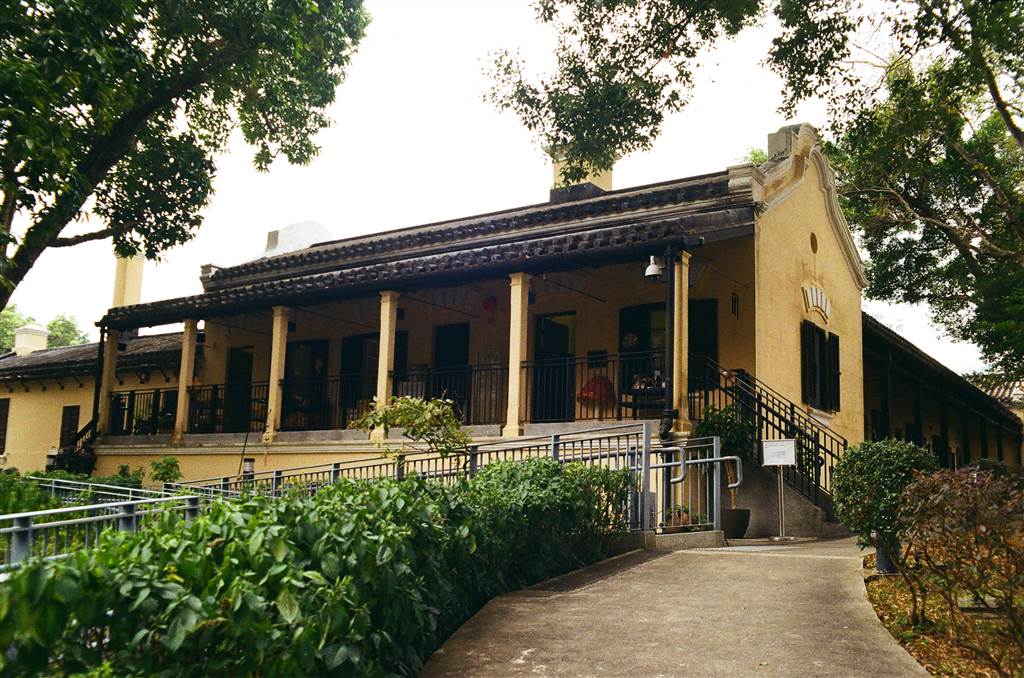
The High Street Haunted House is a beautiful colonial building standing on No. 2 High Street at the corner of High Street and Eastern Street. The restored façade of the former hospital rises beautifully above the food and dining establishment in the vicinity of Third Street, which lies just below High Street.

The proper name of the High Street Haunted House is the Sai Ying Pun Community Complex, now consisting of the façade of the old building and a new, modern community center that gives home to government offices and other community service providers. Some government sources refer to the heritage as the Old Mental Hospital.

It acquired its eerie reputation due to two historical facts. First, in the turn of the 20th century, the complex was once Hong Kong’s largest hospital for the mentally ill. Second, the complex is rumored to have been the site of execution by the Japanese armed forces during World War II as well. The King George V park, across the street from the former hospital, was the site of a mass grave for the executed people.

The History of the High Street Haunted House

Early Beginnings

In 1892, construction for the Medical Staff Quarters of the Government Civil Hospital completed and began service. The government believed that the quiet location in Sai Ying Pun, away from the bustling commercial district on Queen’s Road in Central, would be a good choice for the health of the medical staff.

In 1906, additional quarters served as extended accommodation for more medical staff. Those structures lied on the eastern end of the original building, with the same granite finish as the original medical staff quarter to indicate unity in style and purpose.

Transition into a Mental Health Institute

Fast forward to the times before WWII, and the nurse quarters became a hospital for the mentally ill in 1939 or so. At the time, the Chinese Lunatic Asylum on Eastern Street (now the Old Methadone Clinic) was becoming overcrowded. Many mentally-ill Chinese patients were transferred from Hong Kong to the John Kerr Refuge for the Insane in Guangzhou for treatment. However, as Japanese forces occupied Guangzhou in 1938, the transfer was no longer possible. The nurses’ bedrooms were thus converted into wards for female patients at the Old Mental Hospital.

While official records say little about the building’s use during WWII, community consensus is that it was a military facility for the Japanese during the occupation years. The local understanding of any Japanese use of structures usually comes with speculations about brutality and executions of Chinese compatriots or resistance fighters. And rumors about these former sites used by the Japanese usually come with plenty of spookiness.

After the founding of New China in 1949, transfers of Hong Kong patients to Guangzhou facilities ceased permanently. In view of the pressing need to treat mentally ill patients, the government built the Castle Peak Hospital. It began service in 1961. With this development, the Old Mental Hospital then became an out-patient psychiatric clinic.  It served its final day in its historic role as a mental health institution in 1971.

Disrepair and Restoration

The building came into disuse when it closed its doors to all mental health services in 1971. During the two decades or so of vacancy and abandonment, the building suffered from frequent trespasses from urban explorers and the drug users that were receiving treatments in the old Methadone Clinic across the street. Two fires further destroyed the building.

By the 1990s, when talks began about its restoration, the roof was falling off. Due to cost and structural concerns, the government decided to only restore the façade.

In 2015, the Antiquities and Monuments Office gave the Old Mental Hospital the status of Declared Monument.

The Architecture of the High Street Haunted House

Danby & Leigh (now Leigh & Orange) served as the architect for the original medical staff quarters.

The former structure has two stories and originally it had only ten bedrooms. The restored façade is in L shape, with the long edge on High Street and the short edge on Eastern Street. Only this L-shape façade is preserved out of the original structure. It really only takes about ten minutes to admire the heritage. Yet the façade and the veranda that lies along High Street are both really beautiful.

According to descriptions on site, the building was designed in the Early Baroque style. Built of granite, the façade has stood the test of time. The lower level of the façade has a wide-arched veranda. It is also well-restored for visitors to walk through, and many people line up to take instagrammable pictures there. The pendant lights, the ceiling boards and the timber shutter doors were new additions during the renovation of 2002.

The Antiquities and Monuments Office has the following description on the structure’s other architectural features besides its granite finish:

The fine dressed ashlar mouldings, cornices, quoins and band courses provide an elegant contrast to the heavy rusticated granite blocks. Further graceful effects are achieved by the use of pediments, pinnacles, decorative parapets and ornamental wrought-ironwork balustrading to the verandahs. (The Antiquities and Monuments Office)

The outer finish of the two upper stories show rustic treatment of the granite blocks. The façade on Eastern Street shows beautiful arched entrance ways and windows with dark green window frames.

The spookiness that comes to associate with the structure is a vestige of history. It is haunted for what it stands for, but on its own the building has a classic beauty that is unusual even amongst the many colonial structures of Hong Kong.

A Suggested Itinerary on Nearby Heritage Sites

There are a number of buildings with colonial architecture in this area of Sai Ying Pun. For a quick one-hour walk, I suggest beginning on Western Street at King’s College. It prides itself on its red brick structure. Across the street from the King’s College is the Chinese Rhenish Church, a Grade 3 Historic Building. However, the church is not open for public visit during non-service hours.

Further down on the corner of Western Street and High Street lies the Kau Yan Church. This church is open for public visit during the weekdays. All these three buildings show vastly different architectural styles. They also stand for years of dedication to their respective missions and commitments to the community.

After touring these three sites, walk on High Street on the eastward direction to see the High Street Haunted House. Do note that the Old Chinese Lunatic Asylum (a Grade 3 Historic Building and it also served as a Methadone Clinic) stands across the building’s western façade on Eastern Street. The Methadone Clinic has also completed its historic role, and it no longer serves drug rehabilitation either. However, you may only see just a bit of that structure on Eastern Street.

Then finally, have lunch / tea / drinks in one of the many hip and cool dining establishments on Third Street.

Sources

Ruben Verebes, The Spooky High Street Haunted House in Sai Ying Pun, a Former Japanese Killing Site and Ghost, HangoutTheBeatHK, January 11, 2022.

The Wikipedia on the Sai Ying Pun Community Complex.

The Antiquities and Monuments Office, Declared Monuments in Hong Kong – Hong Kong Island, Façade of the Old Mental Hospital.

The Antiquities and Monuments Office, Heritage Appraisal for the Façade of the Old Mental Hospital.

The Way to Kiu Tau Islet in Sharp Island

The Way to Kiu Tau Islet in Sharp Island

In my last excursion to Sharp Island, I went around 1:30 pm and did not manage to see the Kiu Tau Islet at low tide. I crossed half of the tombolo and had to return. On this sunny autumn afternoon, we could not go on 

Ubiquitously Uzbekistan – Bibi Khanym’s Legacy

Ubiquitously Uzbekistan – Bibi Khanym’s Legacy

Amir Timur ruled via the puppet khans in the khanate kingdoms in which he managed to consolidate his power. This was because Amir Timur himself was not a descendant of the Genghis Khan. Without this lineage he could not become the Khan. He became qurkan 

Ubiquitously Uzbekistan – The Registan of Samarkand

Ubiquitously Uzbekistan – The Registan of Samarkand

The Registan of Samarkand is the very soul of the ancient city’s heritage. Standing majestic in the heart of Samarkand, the Registan has witnessed the turns of history that shaped the ancient city as well as Uzbekistan. Its historic presence represents Samarkand’s legacy as an ancient oasis along the silk road, and the Timurid dynasty’s commitment to culture, governance and learning.

The Registan, meaning “a sandy place,” is the central public place in a given ancient city in Uzbekistan. It served multiple purposes for the ancient citizens of Samarkand. Trade, culture, official administration and Islamic learning in the Registan were breaths of civility that brought Samarkand the grandeur that it stands for today. And as we found out later in the day, this breath of civility would renew in a modern vein.

A Brief History of the Registan in Samarkand

During Amir Timur’s lifetime, activities at the Registan were mostly commercial in nature. There were six main roads that ran through the square. The square was also connected to Amir Timur’s citadel by these roads. There used to be a domed bazaar, but Amir Timur’s grandson Ulug Bek ordered the construction of the Ulug Bek Madrassa, thus perhaps permanently changing the character of the square into historical and cultural. Surely, throughout its ancient existence the open space was often the site for military parades, the public announcement of royal edicts, or even where executions took place, but it was always the heart of all things important for the citizens of Samarkand.

The three grand structures that make the ensemble at the Registan are namely, the Ulug Bek Madrasa to the west (on the left, if you stand on the viewing platform), the Tillya-Kari Madrasa to the north (in the center), and the Sher Dor Madrasa to the east (on the right).

The Ulug Bek Madrasa

The Ulug Bek Madrasa was a work of Ulug Bek between 1417 and 1420. In many ways the architectural designs of the building reflected the learned nature of Ulug Bek himself, especially in all things scientific and astronomical. Against the background of earthy toned bricks are set turquoise glazed tiles laid out in mosaics, their patterns representing the stars in the sky. At a total height of 45 meters the front portal drawfs all human presence in the square.

As a standard design in Islamic architecture, the Kufic inscription declares the magnificence of the architecture itself, “This magnificent façade is of such a height it is twice the heavens and of such weight that the spine of the earth is about to crumble.”

The Ulug Bek Madrasa provided 50 rooms for student accommodation (each room typically housed two students). As an educational institute, the Ulug Bek Madrasa did not limit itself to religious instruction. Students engaged in secular studies, especially in science and astronomy.

The Tillya-Kari Madrasa

By the 17th century, the Mirzoi caravanserai (an inn denoting a resting and trading place for merchants, but most likely this caravanserai served pilgrims) that Ulug Bek built on this site lied in ruins. The ruins of the Bibi Khanym Mosque was also viewed to necessitate a new site dedicated to Islamic learning and worship. As such, Baohir Yalangtush commissioned the Tillya-Kari Madrasa, which includes both a madrasa and a mosque. The building construction completed within a 14-year period in 1660.

Meaning “the Gold-covered Madrasa,” The Tillya-Kari Madrasa has the most elaborate appearance in its pishtaq (front portal) in my opinion. The tile mosaics fully cover the whole brick underlay. They exhibit intricate patterns that are lavish, with a touch of sophistication that somewhat differs from that of the Ulug Bek Madrasa.

The name of the Madrasa came from the decorated interior of the dome, which is gilded in gold leaves. Therefore be certain to check out the interiors of the monument, and look up at the marvel of Uzbek architecture.

Unlike the Ulug Bek Madrasa, where students participated actively in secular learning, the Tillya-Kari Madrasa was conceived with a purely religious purpose. The mosque was for congregational worship.

The invasion by Nadir Shah in the 18th century damaged the dome. Restoration of the dome was only completed in the 20th century.

The Sher Dor Madrasa

Meaning “with lion,” the Sher Dor Madrasa was built by the 17th century mayor Bahodir Yalangtush in Samarkand between 1619 and 1636. The key difference between the Sher Dor Madrasa and the Ulug Bek Madrasa is that there is no mosque in this structure. It provided 52 hujras (student rooms) for students.

In terms of design features, the Sher Dor breaks with Islamic tradition in a key way. Figures of lions (or two felines with lion manes and tiger stripes at the same time) do appear in its pishtaq. Islamic architecture and art typically shun figurative representations of animals. There are very few other examples of this break with Islamic tradition. However, in Bukhara’s Lyab-i Hauz ensemble simurgh birds also adorn the pishtaq of the Nadir Divan-Begi Madrasa.

According to Calum Macleod, “legend claims the architect responsible died for his heresy.”

These three monuments were all lying in ruins by the 18th century. At some point they became the grain storage for Samarkand. In the 19th century, a religious revival again called attention to their significance. Perhaps not surprisingly, the original student rooms at these madrasas are now the small shops for souvenirs and art galleries.

A Wonderful Afternoon Coffee at the Registan

We went through the three structures respectively and by late afternoon we were desperate for a break. There is a coffee cum souvenir shop at the Ulug Bek Madrasa on the second floor. We decided to grab a table and had our afternoon coffee. The owner told us that it was a prime spot for pictures and so he snapped a few very good shots for us. It is such a wonderful experience relaxing amidst the very epitome Samarkand’s grandeur.

The Registan Today

During the warmer months, there is a light show that illuminates the Registan in all colors of the spectrum in every evening. The light show comes at 8 to 8:30pm or so and it goes for about an hour. The lights presented the Registan in an incredible glamor. We stood completely absorbed in the accompanying Uzbek music that celebrated Samarkand. One song rang in our ears repeatedly all evening. We did not understand anything else in the lyrics, except for “Samarkand, Samarkand” sung repeatedly.

One would take a spot at the elevated viewing podium that faces the middle of the public square. It offers a full view of the Registan. Its plaza being enclosed on three sides by imposing monuments, the Registan as an ensemble has centuries’ worth of history behind. We took just a few steps beyond the viewing podium, hoping to take an even more embracing view of the Registan’s grandeur, and only then did we see clearly why there was a crowd sitting at tables before the public square.

The people of Uzbekistan were having a chess tournament that evening. No, it was not chess playing that was the breath of civility that renewed in a modern vein. Amir Timur himself was a serious chess player. What made chess playing a modern vein was rather the tournament. We witnessed the very essence of community that evening at the Registan. The gaming spirit united people from all walks of life. From men to women and from girls to boys, they all gathered under the colors of the Registan and played to the music of their pride.

When we went, we observed many, many Uzbek tourists, especially young students touring in large groups. Some of them asked to take photographs with us. We thought they were rightly proud of their heritage as amply shown in these monuments at the Registan.

Allow a good few hours, perhaps a whole afternoon, for a thorough walk in the structures of the Registan. The picture-taking itself will be time consuming, because of the throngs of tourists there fighting for the prime photo spots. Of course, reserve time after dinner to come back for the light show. It was one of the most amazing experiences I had in Uzbekistan.

Sources

Uzbekistan.Travel on Registan Square.

Descriptions on site at the Registan of Samarkand.

Moya Carey, An Illustrated History of Islamic Architecture (2012).

Sophie Ibbotson, Uzbekistan, Bradt Travel Guide (2020).

Dominique Clevenot & Gerard Degeorge, Ornament and Decoration in Islamic Architecture (2000).

The Collinson Battery Search Lights

The Collinson Battery Search Lights

The plan of the day is to visit the Cape Collinson Battery Search Lights via the Leaping Dragon Path in Siu Sai Wan. We began at the Siu Sai Wan Promenade and hiked up on a gentle incline to reach the Search lights of the