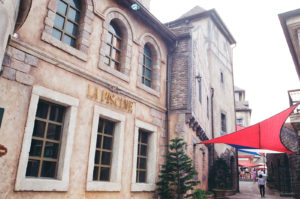
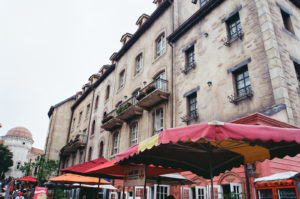
I arrived at the Chauderon station this morning. Not far ahead stood the eye-catching Rolex building on the block. I remembered it from yesterday and knew that there would be a bit of walk to the Vieille Ville, the Old City of Lausanne. Soon I …
The Walled City area had its beginning more than eight hundred years ago in the Song Dynasty. The Kowloon City and the neighboring Kwun Tong area of Kowloon used to be salt fields. With a decline in salt production, the salt industry eventually fell into …
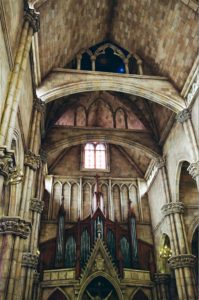
The Lausanne Cathedral stands at the highest point of Lausanne’s Old Town. Overlooking the City of Lausanne, the Cathedral enables a view of the Lake and the Alps afar as well. Its long history furthermore provides a vantage point of spiritual and cultural significance.
The Cathedral was constructed during the 12th and 13th centuries. In 1275, Pope Gregory X and Rudolf of Habsburg consecrated the cathedral. In 1536, it became a Protestant cathedral during the Reformation era. Pierre Viret, the first Reformer of Lausanne, has studied alongside John Calvin. Following the adoption of Protestantism, the formerly very ornate Cathedral suffered from Reformist iconoclasm.[1]
I have little understanding of the architectural and interior features of the Cathedral, but I did notice the beautiful windows with colorful panes. The decorated windows depict the “medieval view of the world arranged around the figure of God the creator.”[2]
Perhaps the most special feature of the Lausanne Cathedral is the watchman. For more than six hundred years, a watchman would climb hundreds of steps up the Bell Tower every evening. He would announce to the city residents each hour from 10pm to 2am, shouting at each cardinal direction. Originally, the watchman served the function of warning the city in case of emergency. Gradually however, it has become a tradition that never ceased. Currently, the lookout is Renato Hausler.[3]
Finally, the organ of the Lausanne Cathedral is itself worthy of a visit. A product of organ builder Fisk, an American company, the organ prides itself in 7,396 pipes, 5 keyboards and pedalboards, and 2 consoles.[4] Four styles of organ building are present: French classical and symphonic, and German baroque and romantic. Giugiaro, the Italian designer known for Ferrari and Maserati cars, designed the case of this organ. The design symbolizes an angel with spread wings. As such, this organ is the first organ in the world that was designed. Last, but not least, the organ inaugurated in 2003, and the Cathedral holds concerts periodically. Twenty-five recitals coincide with the Christian calendar.[5] Concert programs are available here.
Today, the City of Lausanne is perhaps the best known for the Lausanne Movement of 1974. It is a contemporary movement in world evangelization. Billy Graham initiated the first Congress. Delegations from around the world still meet periodically for the International Congress for World Evangelization, where they pray and discuss strategies for world Christian missions.
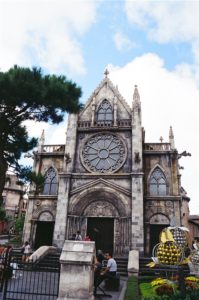
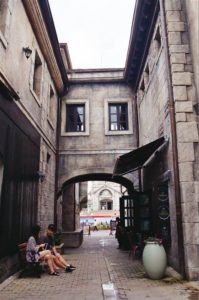
These following are the pictures of a quick first tour of the Lausanne Old Town following the Lausanne Cathedral.
We are expecting an epidemic in Hong Kong. As the city is half-paralyzed due to a government shutdown, and the malls are no longer safe to visit, what is there to do but to visit the countryside? On this chilly winter morning, my friends and …
24 hours later, I arrived in Geneva. Despite it being the hub of international and diplomatic missions, the Geneva airport was down to earth, or perhaps too primitive for the cosmopolitan reputation of the city. There were two lines at the Geneva airport. One for …
A lesson in Australia’s history would not be complete without the history of Port Arthur. It began in the 1880s as a penal colony. Then lieutenant governor of Van Diemen’s Land, George Arthur, established Port Arthur as a settlement for the most incorrigible, repeated offenders from Great Britain and Ireland.[i] The juvenile offenders, on the other hand, would end up in Point Puer, also within the settlement. The idea was that hard labor, psychological punishment, trading and religious education combined would reform even the worst of all convicts.[ii]
Port Arthur
Port Arthur situates on the southwestern coast of Van Diemen’s Land. The penal colony inherited natural barriers that prevented the convicts from any kind of escape. The convicts then understood that the waters surrounding the three sides of the penitentiary was infested with sharks.[iii]
Visitors to the Port Arthur historic site would not miss the theme of the site’s history. We went through a very thoughtful exhibition of the life of the convicts there. The research was thorough, and focused on the life stories of the convicts (as opposed to presenting institution-focused presentations that are probably quite typical to penitentiary museums). These stories allowed me a look into the human face of the otherwise haunting ruins that is Port Arthur today.
The Guard Tower at Port Arthur
Pack of Thieves: George Hunt
George Hunt stole a handkerchief worth two shillings in London and he was sentenced to transportation in Port Arthur. During his time at Port Arthur, George Hunt attempted to escape a dozen times. One of his ploys was disguising as a hopping kangaroo to escape. He failed, however, when a soldier lifted his musket thinking that dinner was ready. Seeing that he was about to be shot, George Hunt raised his human hands and yelled, “don’t shoot!”
George Hunt’s erratic behaviors earned him the assessment of being a lunatic, and he has spent time in the New Norfolk asylum (for the mentally ill).
In his days in Van Diemen’s Land, George Hunt “was charged no less than sixty-four occasions. He spent over 1,800 days in leg irons, received 625 lashes and spent 131 days in solitary confinement.”[iv] However, he did receive a certificate of freedom in 1846.
Certainly, life was very harsh in the penal colony. The worst convicts had to work in chained gangs and in knee-deep water at the coal mine. Any kind of miscreant behavior, be it disrespectful language or attempts to abscond, commonly invited lashes, leg irons and solitary confinement as punishment. The most serious crimes, such as murder, were punishable by death.
Yet at the frontier of a new settlement there also was hope. Many of the convicts, particularly those that came with skills or acquired such at the settlement, could participate in trade. Once they have served their sentence, they could receive a certificate of freedom and remain in trade in Port Arthur, Hobart and beyond. In this sense they were more so the early settlers that made Australia, than the unwanted law-breakers that England sent away.
After viewing the exhibition of convict life, we exited the administration building and came face to face with the structures that served various different purposes at the penal colony. There were many buildings of significance, but I only had time for a few.
Significant Structures at Port Arthur
The Penitentiary
The Penitentiary was the most notable structure in Port Arthur and its significance would be second to none as well. At its construction, the Penitentiary was a flour mill and a granary, but due to engineering defects it could not serve its intended purpose. Originally, the plan was to produce the flour to feed the convict population and to produce food for export. It later became the penitentiary that hosted the dormitories and solitary cells for the prisoners.
The Convict Church
Church service on Sundays was mandatory for all prisoners, and the prison establishment also strictly observed Sabbath. Although the Convict Church is in ruins now, as a work of the prisoners at Port Arthur it stands as a memorial to the use of religious instruction as a way to reform offenders.
The Separate Prison
The Separate Prison claims itself as the first institution of solitary confinement in the Southern Hemisphere. Many of Port Arthur’s convicts faced solitary confinement as an additional punishment to other forms of punishments (that failed to reform them) in Port Arthur. During the days that Port Arthur remained a penal colony, solitary confinement was a new philosophy in criminal justice. The prisoners supposedly sat in silence and darkness to reflect on their own wrongs. Even then, there were reports of prisoners suffering from delusions after days or up to a month in the Separate Prison. While solitary confinement is still a feature in most penitentiaries of the world, its ill effects on the prisoners’ mental health is uncontested now.
The Commandant’s House
The Commandant’s House was the home to five Commandants at Port Arthur. They served as the most senior official in the penal colony. The house was well-preserved, and bespeaks a lifestyle of luxuries that the penal colony could afford. Located at the far western high grounds of Port Arthur, the Commandant’s house overlooks the sea and the Isle of the Dead.
The Isle of the Dead
The final tour of Port Arthur would be the ferry ride going around the Isle of the Dead. This would probably be the most eerie part of the tour. The Isle of the Dead was the burial ground for the settlement. It is a small isle off the shore of Port Arthur. Officers and convicts alike were buried there, but for a very long time only the officers had proper gravestones memorializing their lives.
A Tragedy in Modern Times
Finally, in the modern times Port Arthur was the site of a horrendous killing. In 1996, a man armed himself with a gun and rounds of ammunition and rampaged the whole area of Port Arthur including the historic site. He killed more than thirty people, and injured many more. This incident has resulted in the passing of strict gun control laws in Australia.[v]
Now, a memorial garden at the site serves to remember this incident. Visitors should refrain from starting a conversation with the staff at the historic site about this very horrible event. Many have lost loved ones on this day.
The trip to Port Arthur concluded our tour in Tasmania. My only regret was that I did not have the opportunity to see all the structures at the site. For the history buffs there, my recommendation is to spend two days at the historic site. The guided tour is a must, but it only covers some of the more prominent sites and not the rest. The tour of the Isle of the Dead (a haunted tour in the evening) would be a very nice addition to the experience as well. And to do the guided tour plus a visit on all the structures alone requires two half-days or one full day.
Generous sunshine blessed our last day in Tasmania. We were on our way to Port Arthur. However, we detoured and stopped by a number of interesting natural sites. The Tasman Arch The Tasman Arch began as a small sea cave. Constant sea waves formed …
You don’t know what you got till it’s gone, and that is the story of the China Café. I visited this old-schooled, Hong Kong styled café on December 28th, 2019. This is one of its very last days before saying goodbye to Hong Kong. …
In our last full day in Tasmania, we visited the Wineglass Bay lookout. Note, though, that we did not visit the beach. The tour guide told us that the hike down the beach was very rigorous, going more than two to three hours each way. Most people just hike up the lookout and take pictures. In that way they can claim to have seen it. Fine by me, for my mother and my aunt at their age could not have done a rigorous hike.
The Wineglass Bay has been voted the most beautiful beach in the world. It was in a curvature resembling a wineglass, as its name suggests. The hike up the lookout took us between one to one and a half hours each way. We kept at a reasonable pace until at one point the incline steepened significantly. The very last part of the hike up was rigorous. We climbed a long set of high steps.
Once up at the lookout, we only needed to take one five-minute look at it—Wineglass Bay had pristine waters and impeccable sand. Since I did not want to fuss with renting a car and making a whole-day trip to see it, that was as good as it gets.
Overall the visit to Wineglass Bay was a nice walk in the nature and a nice view at the finish. On our way back we also visited the Swansea area, which is a seaside village famous for its oysters. We saw reports of pollution and its effects on oysters, and therefore all of us passed on having any. But if anyone were to have some, they are freshly shucked and slurped on the spot.
Particularly worthy of mention is the famous Kate’s Berry Farm. All the fruits in the jams were the produce of Kate’s own farms. Tasmania’s cold climate made it possible for the jams to feature all kinds of berries. My favorite was the raspberry jam. There was an interesting texture from the raspberry seeds in the jam. Unlike the regular jams on the supermarket shelves, Kate’s berry jams really, and I cannot emphasize more, really tastes miles better. They taste like fresh fruits, rather than the sugary preservatives. Finally, the strawberry ice-cream there was fantastic. The milk must have come from the farm as well. I do highly recommend a visit there.
We finished the evening at Solo. According to reviews, this would be one of the very best restaurants in Hobart. It was reasonably priced with excellent service. We enjoyed our food:
The Jackman McRoss was a local bakery just a stone’s throw away from the Montacute. We decided to get our breakfast there, since all tourist sources recommended it. It clearly was a local favorite. We felt the energy of the place as soon as we …