
To the Outback and Back — The State of Affairs of the Aboriginals in Australia
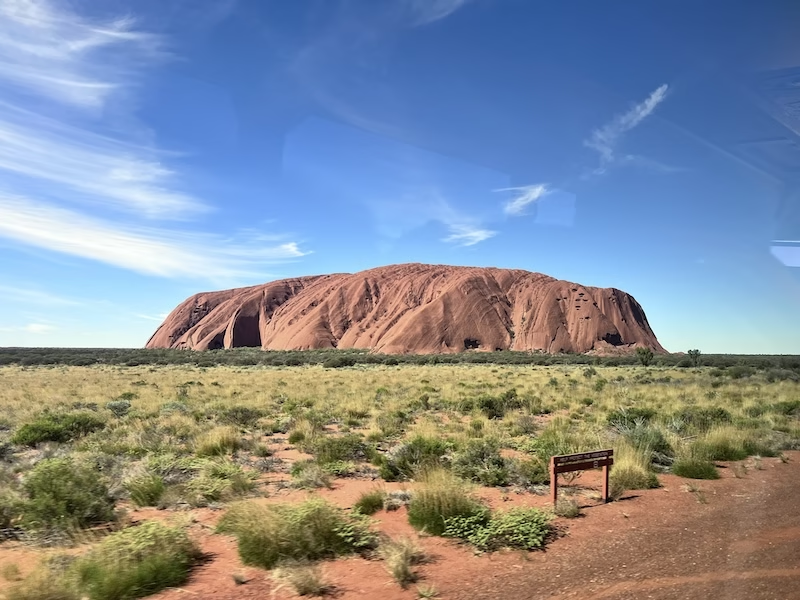
One cannot understand the human face of the Outback without a fair appreciation of the state of affairs concerning the Aboriginals in Australia. In this last entry on the Outback, I attempt to provide a brief overview of the historical issues that have direct bearings on the welfare of the Aboriginals in Australia. I am not Australian and I do not represent or advocate for any party on this issue. This is my own learning on an issue of significance as it matters to Australia today.
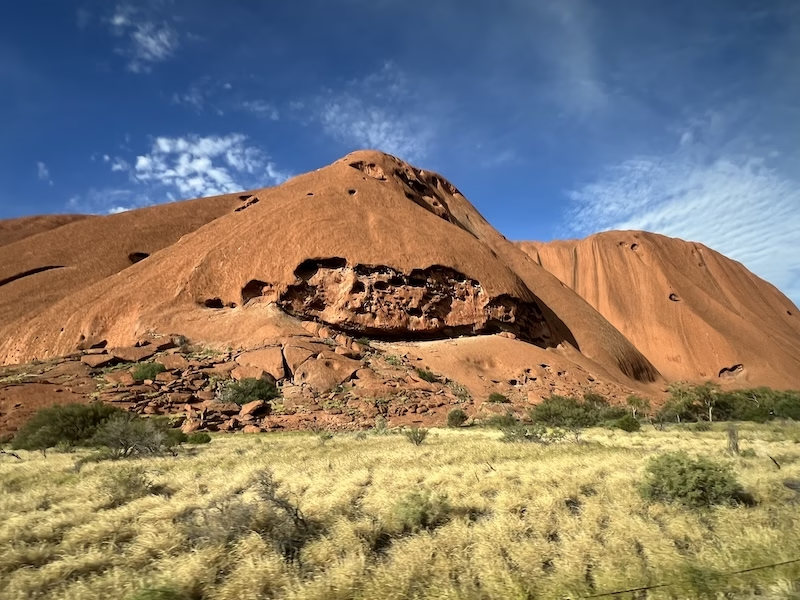
A brief research on articles online reveals two underlying currents of developments concerning Aboriginal rights in Australia historically. The first is the contention over the natives’ rights to the land that they had inhabited for tens of thousands of years. The second is the policy of removal of Aboriginal children (at the earlier times, specifically children of mixed blood) from their families with the stated aim of societal integration or child protection. These are the issues that continue to resonate in Australia.
The Stolen Generations
The term “Stolen Generations” refers to the innumerable Aboriginal children that were forcibly removed from their native families and communities pursuant to the government policy of removal. This policy of removal is purportedly done for the sake of assimilation of Aboriginal children into the society, clothed in the name of “child protection.”
The forced removal of Aboriginal children was a practice in a few of the former commonwealth countries that have had to confront the historical tensions between colonist settlements and the rights of indigenous peoples. This includes the United States, Canada and Australia.
The Aboriginals were very much tied to the land and they formed intimate bonds with the land. Before the child even learned to walk, he could recognise the footprints of his whole family. Throughout his life, he would be learning cues from nature for all kinds of survival skills. The Aboriginal children were born in the sand. The baby was washed in the sand and it would forge a lifelong relationship with the land.
The Aboriginals’s lives evolved with this land throughout thousands of centuries. The climate was once tropical in the Outback and now it has become a desert. They had the skills to tell where the water is, the hunting etc. They never wore clothes and yet they could survive extreme temperatures. When they were put into settlement communities, they lost their distinct sense of the earth.
The Aboriginals also have strict rules about with whom someone may have children. When the children were taken away, they did not know what their bloodline was and as a result there was inbreeding.
From around 1905 to 1967, forced removal of Aboriginal and Torres Straits Islanders children was a systematic practice. Under various legal arrangements, the authorities would take the (mostly half-caste) Aboriginal children away from their mothers, and often at birth. Sometimes the authorities simply told the parents that the child had died. Similarly, for the children taken away, they would grow up being told that their parents had died as well. It is estimated that during the material times, 1 in 10 to 1 in 3 Aboriginal children were taken away from their parents.
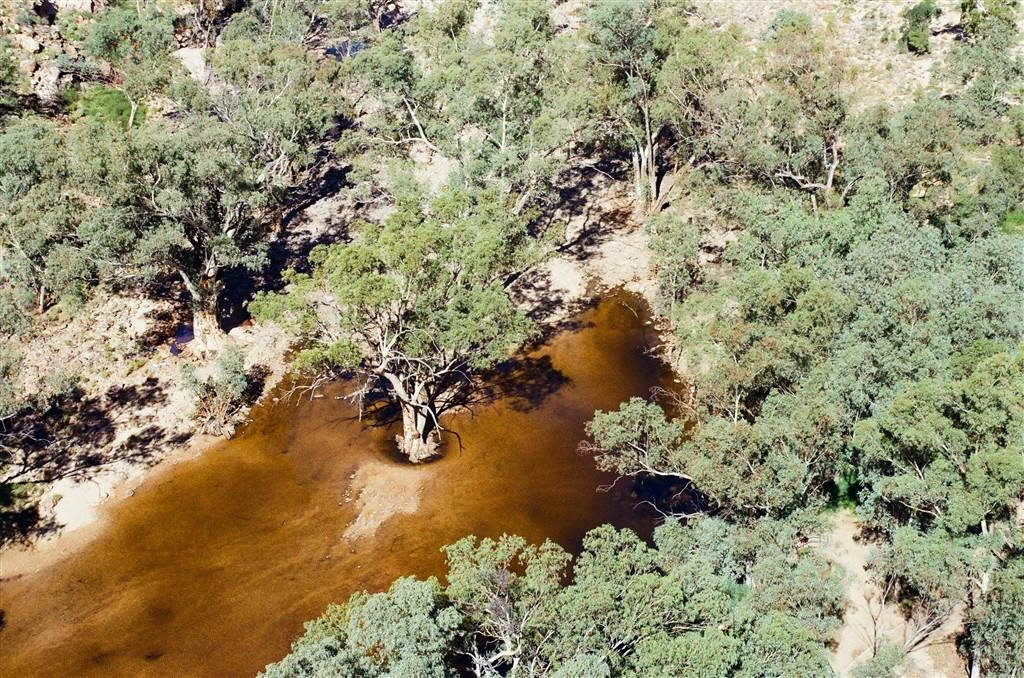
The Relevant Laws
The legal developments that concerned Aboriginal affairs in Australia had not always been so vicious. But a patonizing sentiment was present, in that the Aboriginals were viewed as subjects to be “protected” and not really as citizens that had recognized and actionable legal rights. Take South Australia as an example. The Letters Patent of the colony includes a clause that guarantees any “Aboriginal Natives” or their descendants to lands they “now actually occupied or enjoyed.” In 1836, the “Protector of Aborigines” was appointed to protect the undisturbed possession of their land. There was also effort to introduce the Aboriginals to the perceived “more civilized” way of life, such as farming in reserves.
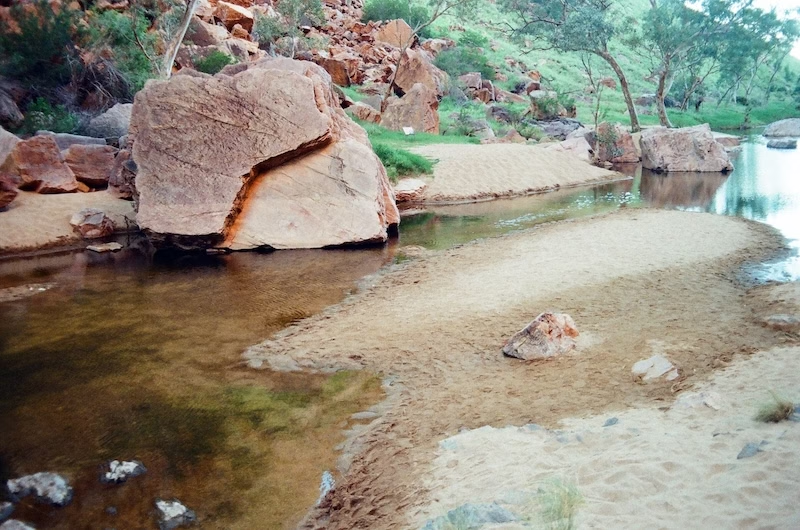
In the Aborigines Act of South Australia (1911, 1923 and 1934), the government invoked the power that resulted in grave consequences to the Aboriginals. Amongst others, the Chief Protector and Guardianship was appointed to oversee the removal of Aboriginal children from their parents. Furthermore, this law introduced the policy of segregation and commandment of resettling Aboriginals into “communities” and limiting their movements in and out of the reserves.
Perhaps the policy of removal was first expressed in the Aboriginal Protection Act 1869, which was a legislation of Victoria. This legislation allowed the removal of Aboriginal people of mixed descent from the Aboriginal reserve forcebly, so that they could assimilate into the Anglo-Australian society. In 1883, the Board for the Protection of Aborigines was established in New South Wales. Although it acted without legislative authority at first, it was given the authority to remove children by the Aborigines Protection Amending Act 1915 (NSW), without having to first establish in court that the children were neglected.
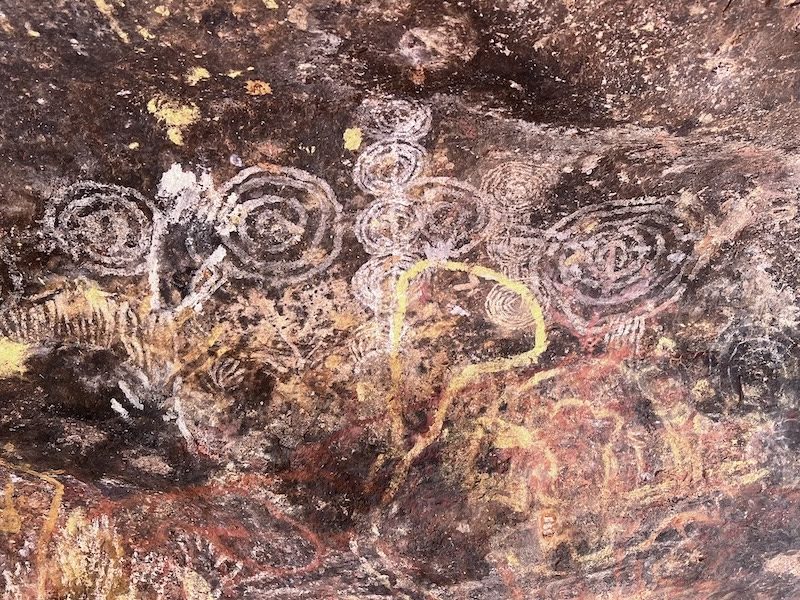
The practice of removal was appalling beyond the forced disablement of an Aboriginal child’s instincts about nature. The children would grow up in a home or in foster care. They were to learn life skills in the home, so that when they left, they could be of use to the Anglo-Australians as servants or farm hands. It goes without saying that the Aboriginal children suffered neglect, at best, and abuse, at worst, at these homes. The purported objective of the so-called “protection” policy fell flat on its face in practice, let alone the unmistakeably racist views that motivated the policy.
As to the point of racially motivated policy, it is worth mentioning that Australia adopted a White Australia policy during 1901 and 1970, with the passing of the Immigration Restriction Act, which restricted non-white (it really intends to exclude non-British) immigration. That is not Australia today, for sure. And to be fair, such similar policies did also take shape in the United States (then already independent) in around the same time.
The Aboriginals’ Right to Land
In a previous entry on Alice Springs, I have discussed the tensions that arose when the Anglo-Australian settlers occupied the frontier lands of the Outback freely, touching off the Coniston Massacre of 1928. This incident was representative of the kinds of issues concerning the occupation and use of land and other resources against the interests of the Aboriginals.
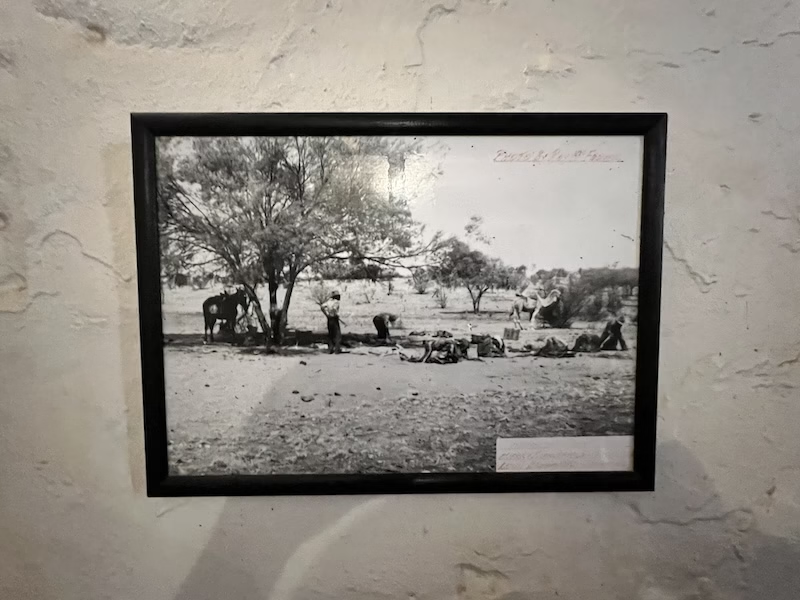
But post WWII nuclear tests in the Outback have rubbed salt into wounds, and amplified the problems multifold. The British and the Austraslian governments together had done more severe and long-lasting damage to Australia’s native land and its peoples, particularly in the Outback, than the continuous frontier skirmishes. The nuclear tests conducted between 1952 and 1957, and the radioactive waste dumping thereafter, resulted in life-threatening consequences for the Aboriginals and the natural evironment. The irony is, the Anglo-Australian colonists took the land away from the Aboriginals, and with final recognition today of the wrong done, Australia “returned” the land to its original owners, only that it was already dangerously contaminated.
Reconciliation and Reparations
Reconciliation
In the case of South Australia, some notable efforts to recognize indigenous rights began around the 1960s. The Aborigines Affairs Act abolished the powers to remove Aboriginals to the reserves in 1962. The Aborigines and Historic Relics Preservation Act of South Australia provided some protection of sacred and burial sites and other sites of significance beginning in 1965. In 1968, the Aborigines Affairs Amendment Act finally prohibited the forced removal of young people.

Nationally, in 1962, the First Peoples won their rights to vote in state elections after lobbying. The 1967 referendum was perhaps the singlemost significant turning point for Aboriginal rights. In this referendum, 90% of Australians agreed that First Australians deserved equal constitutional rights. The result was reflected in the removal of discriminatory wordings from the Australian Constitution, allowing the Federal Government to make laws concerning the Aboriginals and the Torres Strait Islanders, and counting them in the national census. With a 90% vote affirming the referendum, the 1967 referendum is still the most successful in Australian history.
In 1982, the Torres Strait Islanders were the first to bring a formal claim for their native rights to land in the courts. The first point of legal significance is the recognition of native rights to land as opposed to legal titles to land. The difference between the two is that common titles to land as a freehold is a government creation of land rights. In contrast, the native rights to land originates from the common law requiring a recognition by law on an inherent right to land.
In Mabo v. Queensland, the Supreme Court of Australia recognized, for the first time, the indigenous people’s native rights to the land. A group of Torres Strait Islanders sued to overturn the legislation called Torres Strait Islands Coastal Islands Act, which denied the rights to any land claimed by the islanders that arose after the claim of sovereignty in 1879, and with no compensation. The applicants, as peoples of the Torres Straits in the Island of Mer (Murray Island), relied on the Commonwealth Racial Discrimination Act as the crux of their argument.
This 1992 judgment is a watershed that would start the ball rolling for the process of recognizing the indigenous rights to land in Australia. The judgment recognizes pre-existing rights and interests in land, that such rights survived colonization and still survives today. Where government actions extinguish such native titles to land, the islanders are entitled to just compensation post 1975. The just compensation requirement is contained in the Racial Discrimination Act of 1975, on the basis that if the indigenous peoples did not get compensated for land taken, and other non-natives did, then it is considered racial discrimination. Following this judgment, a few critical cases with similar claims were won by the Aboriginals in other parts of the country.
Another development is an inquiry done by the Australian Human Rights Commission, which published a report called Bringing Them Home in 1997. Drawing upon the tesimonials of Aboriginal and Torres Strait Islanders that were forcibly removed in every jurisdiction in the nation, the report exposes and affirms the inhumanity of the practice.
In 2007, Australia became a signatory to the United Nations Convention on the Right of Indigenous Peoples. This was followed by Prime Minister Kevin Rudd offering a formal apology to Australia’s indigenous peoples, in particular to the Lost Generations, on behalf of the national government in 2008. The first National Sorry Day was held on May 26, 2008, standing as a national acknolwedgement of the injustices done to the First Peoples.
Reparations
Perhaps the recent developments in the Aboriginals’ native rights to the land can only do so much to rectify the grand scheme of injustice that has been done to them for more than a century. For the lost generations of Aboriginal children, all states but Queensland has provided mechanisms of reparations to them.
Fast forward to 2023, the latest referendum that concerns the Aboriginals called for a vote to recognize the First Peoples in the Australian Constitution by establishing the Aboriginal and Torres Strait Islander Voice, which was envisioned to be a body in the Parliament that represents and advocates for the indigenous peoples of Australia. The referendum was roundly rejected by the Australian voters.
Reconciliation and remedies are a long path to tread, as with all nations similarly situated. But they all began with recognition of the wrong done to the First Peoples. At least that much is clear in Australia.
Sources
AIATSIS, Mabo v Queensland (No 2) [1992] HCA 23; (1992) 175 CLR 1.
Australian Museum, The Stolen Generation.
The Britannica on Stolen Generations.
Caroline Webber, ‘Equal Rights for Aborigines,’ Indigenous Activism and Constitutional Reform, National Archives of Australia, May 20, 2020.
Kristy Wilson, Fallout in the Outback: Nuclear Colonization and the Aboriginal People in Australia, University of Colorado.
ngutungka.com, Aboriginal Timeline SA.
The Wikipedia on Stolen Generations.