
To the Outback and Back — Lest We Forget at Anzac Hill in Alice Springs
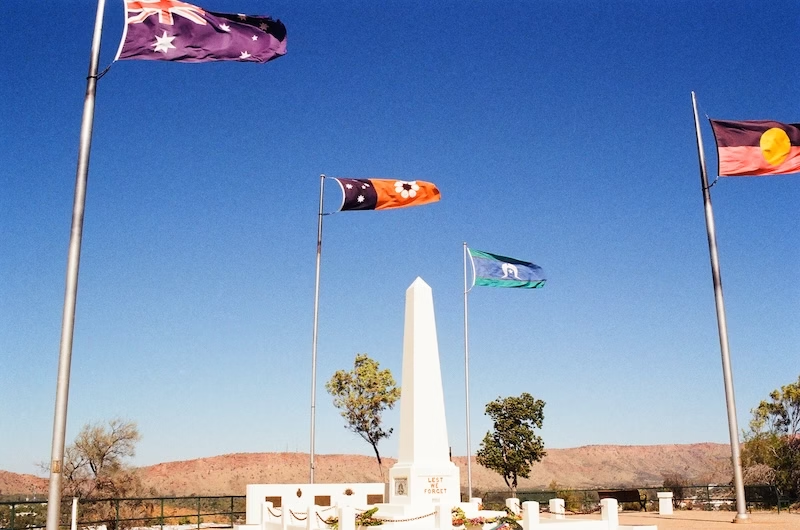
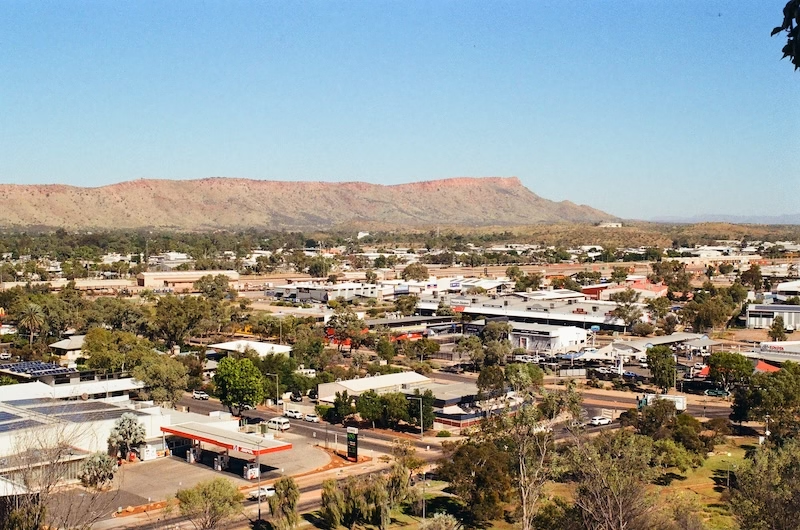
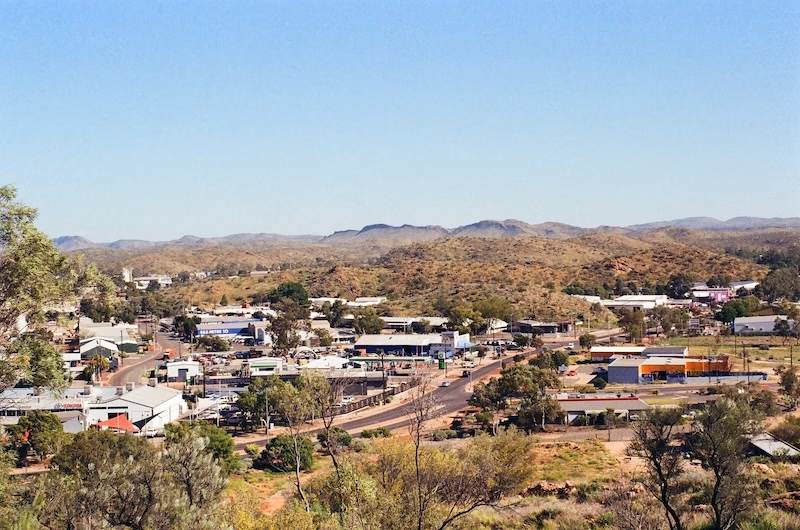
There are half-day tours that take you around the historical, cultural and natural sites in Alice Springs. I opted to keep things simple after three days of intense tours in the Outback. In the morning of my day of departure, I walked from my hotel to Anzac Hill, where you can see the city in a 360 panoramic view.
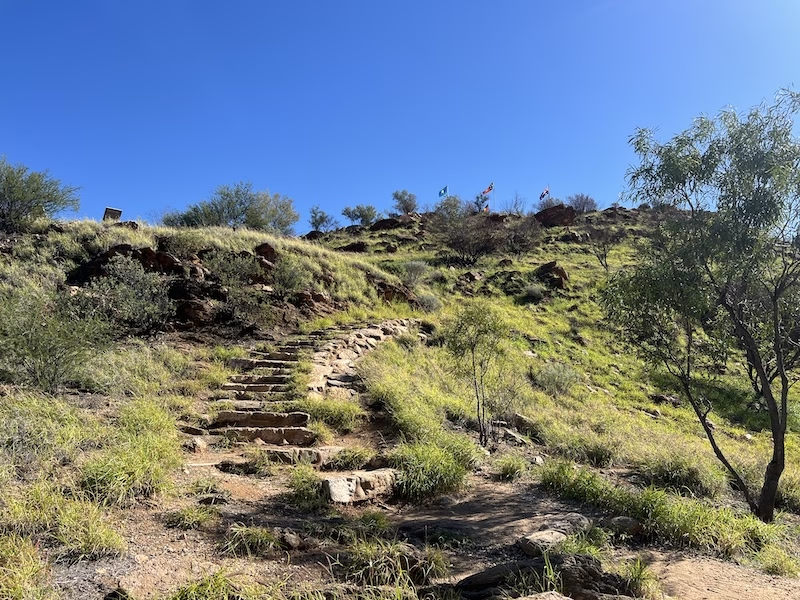
In the Outback, any “Australian” construction would entail some explaining of its former significance to the Aboriginals. The original Aboriginal life that was supplanted by European settlement is a subtext in Alice Springs, but it is acknowledged in an even-handed manner. The area now known as Anzac Hill was Untyeye-artwilye to the Arrernte Aboriginals. The two words together means “corkwood story,” and so as the Dreamtime goes.
The Dreamtime has to do with a woman ancestor who lived on the hill without the company of men. The most signficant Dreamtime at East Mac, concerning the Three Caterpillars, finds its relevance here as well, as in a rock in the Todd River into which an Ancestor morphed.
ANZAC is a term that comes up very often in Australian life. It stands for “Australian and New Zealand Army Corps.” Being true to its name, the appearance of Anzac has to do with Australia’s warrior past (or peacekeeping missions, depending on your perspective). In fact, the Anzac day is a national day of commemoration for the Gallipoli landing by the Australian troops during World War I. The commemoration has been 110 years in the running.
Anzac Hill
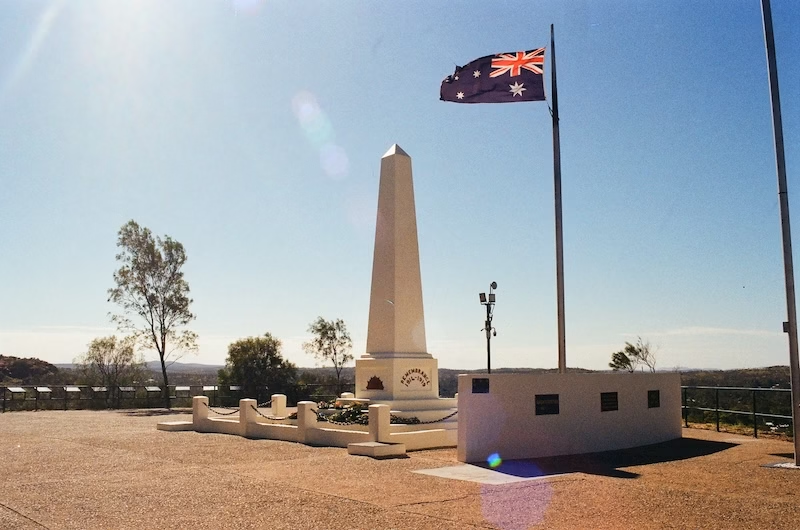
At Anzac Hill, the history of Australia’s involvement in WWI is amply shown in the open-air museum. In its beginning in 1934, the Anzac Memorial commemorated those who served in WWI. It has evolved to serve as a site of remembrance for all those who served in the wars in which Australia involved itself.
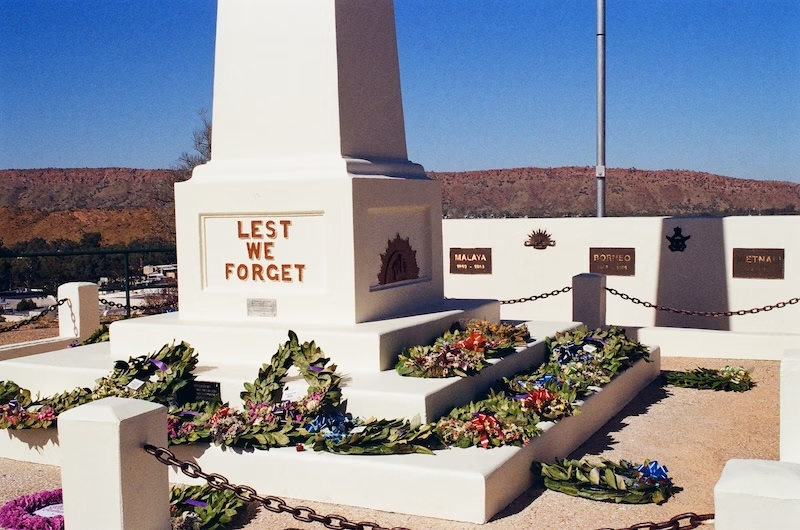
The Anzac Memorial is simply a memorial structure surrounded by flags of significance. But the spirit flies high under the generous sunshine of a day in the depth of the autumn. I took a solemn moment to salute to the sacrifices that Australians have made to world peace. Their contribution to world peace, not least to ending the Pacific War, is not nearly acknowledged enough in global politics.
During World War II, Alice Springs was a major military camp that served as the arsenal and staging point for supplies to Darwin, which was Australia’s warfront in the Pacific War. In 1940, an advanced party of military personnel arrived to prepare a camp for the Darwin Overland Maintenance Force (DOMF) in Alice Springs. The city became a key stopover for the supply fleets to Darwin, and later the administrative center and the de facto capital for the state in 1942. The warfront at Darwin consisted of both the defence of the homeland and the fighting against the enemy in occupied territories.
I took another solemn moment to salute to Australia for being the first country that I could call home as I lived here for a year after leaving Hong Kong. I was educated here, perhaps not long enough, but my Australian experience opened my eyes to a way of life that was hitherto incomprehensible in my narrow-minded existence in Hong Kong.
Here I want to emphasize my approach to world traveling that is perhaps evident to the readers of my blog. I take keen interest in world history, especially 20th century history and WWII. In my travels, I make special effort to learn about the differing worldviews that emerged from this history, and try to make sense of the learned experience that still affects people’s perspectives today.
At Anzac Hill, the efforts and sacrfices made by the Australians and New Zealanders in the wars of the 20th century are in sharp focus.
War Narratives at Anzac Hill
The open-air museum is very thorough with war history and it features all the wars with detailed explanations and an exclusively Australian perspective. Perhaps I can discuss an event in WWI that I learned there.
Australia’s wartime loyalties have always lied with the traditional allies of the western world, chiefly with Britain. In Anzac Hill, the Australians’ WWI efforts were memorialized in the Fromelles Battle. It was deemed the worst 24 hours of Australia’s entire history, whereby more than 5,500 Australian soldiers died in one battle. This number exceeds the total war casualties of Australian troops in the Boer War, Korean War and the Vietnam War together.
Fromelles was part of the Western Front in the war against Germany during WWI. It was due to British command that the allied troops would launch an assault against Germany from French Fromelles on July 19, 1916. It was meant to be a diversion to stop the Germans from reinforcing their units on another part of the Somme front, where the Allies had launched an attack on July 1.
The troops had just arrived at the Western Front, and Brigadier General Elliot did not even have a map to work with. They were ill-supplied, poorly trained and up against inherently disadvantageous terrain and visibility. Going in, Brigadier General Elliot knew it was a situation that had no tactical justification. He urged the higher chain of command to reconsider the decision for an offensive, it was to no avail, the full-scale attack was only delayed.
The Germans occupied a higher vantage point from their bastion, with machine guns piling and aiming at the advancing battalions. The troops, most of them were Australians, were wiped out as they stammered up the hill. In the end, the allies secured no German positions. But the diversion objective was somewhat met — at the expense of 5,500 Australian lives.
The Fromelles Battle was the first major battle fought by the Australians in the Western Front. It leaves a searing memory in Australia.
A Shocking Revelation of the Northern Territory’s Role in the Surveillance Race
In my long conversations with Kirsty of Red Earth Roaming during the East Mac tour, we touched upon the ongoing conflicts that are troubling the world. “Would you say that you are in a relatively safe and peaceful place being in this part of Australia, away from the conflicts of the world?” I asked, in ignorance, assuming erroneously that the joyful desolation of the Outback has no relevance in the map of world conflicts. She pinned the Northern Territory on the war map for me right away, “no, not so. You know that the Americans run their satellite surveillance operations? The eavesdrop base for the Southern Hemisphere is right here.”
In shock, I learned about the Pine Gap collaboration between the U.S. and Australian governments, what has been 30 years in the running already. So, there were the beautiful Simpsons Gap in West Mac and Emily Gap in East Mac, and Pine Gap is a military setup? There is perhaps no part of the world that is free of war implications. I sensed a certain unease in Kirsty’s voice, but what are we gonna do about these things?
Sources
Descriptions on site at Anzac Hill, Alice Springs.
What is Anzac Day Mean and How did it Begin? Kids News, April 23, 2026.
Alice Springs in WWII, Northern Territory.
Battle of Fromelles on 19 to 20 July 1916, Anzac Portal.